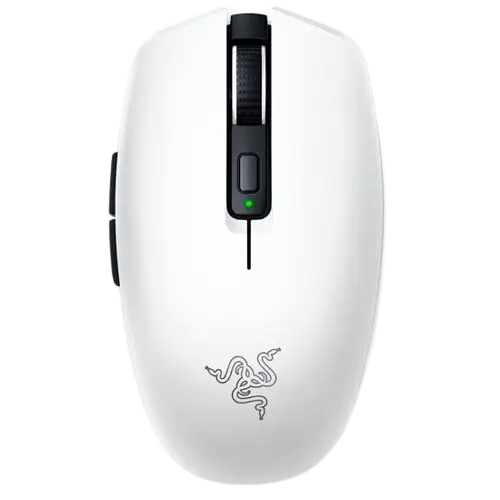
Razer Orochi V2
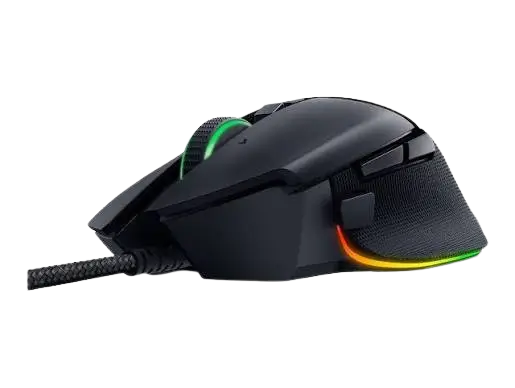
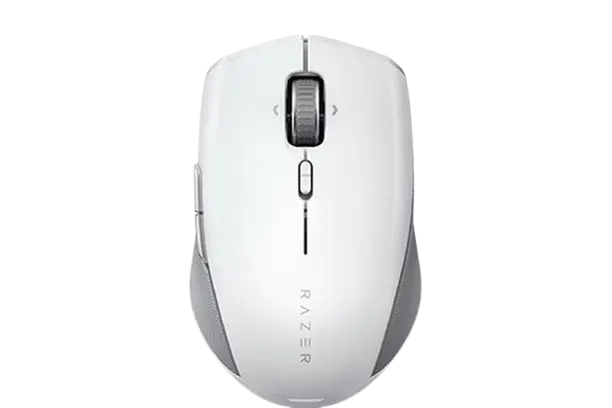
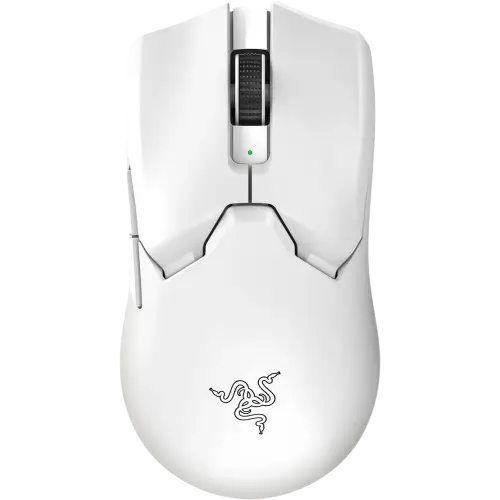
The Razer Orochi V2 is a compact, lightweight wireless gaming mouse with a symmetrical right-handed design and six independently programmable buttons. It connects either through Razer HyperSpeed Wireless (2.4 GHz) with the included USB dongle or through Bluetooth, and it runs on a single AA battery (an AAA battery also works). A DPI cycle button switches between five sensitivity stages, and the status indicator changes color to show the active stage, connection state and low battery. The Razer Synapse software adds button remapping, sensitivity stages, polling rate, surface calibration and power settings.
Parts and What’s in the Box
Mouse parts
The diagram labels the following parts:
| Label | Part |
| A | Left mouse button |
| B | Right mouse button |
| C | Scroll wheel |
| D | DPI cycle button |
| E | Status indicator |
| F | Mouse button 5 |
| G | Mouse button 4 |
| H | Wireless USB dongle |
| I | Ultraslick mouse feet |
| J | True 18K DPI 5G optical sensor |
| K | Slider switch |
The slider switch (K) has three positions: Razer HyperSpeed Wireless (2.4 GHz) mode, power off mode and Bluetooth mode. Your serial number is on the underside of the mouse, as shown in the guide’s diagram.
Package contents
- Razer Orochi V2
- 1 x AA battery
- Important Product Information Guide
What you need
- A USB-A port or Bluetooth 5.1 connectivity
- 1 x 1.5V AA battery (also compatible with an AAA battery, not included)
- For Razer Synapse: Windows 7 64-bit (or higher) and an internet connection for software installation
Technical Specifications
- True 18,000 DPI 5G optical sensor with 99.4% resolution accuracy
- Up to 450 inches per second (IPS) / 40 G acceleration
- Razer HyperSpeed wireless technology with support for dual-device operation on a single dongle
- Dual-mode wireless (2.4GHz and BLE)
- Six independently programmable buttons
- 2nd-gen Razer Mechanical Mouse Switches rated for 60M clicks
- Symmetrical right-handed design
- Gaming-grade tactile scroll wheel
- Undyed PTFE mouse feet
- AA/AAA battery slot (only one type at a time)
- On-the-fly sensitivity adjustment (default stages: 400/800/1600/3200/6400)
- On-board DPI and keymap storage
- Razer Synapse 3 enabled
Getting Started
Insert the battery
- Remove the top cover of the mouse and insert the AA battery as indicated in the battery compartment.
- Reattach the top cover and make sure it is tightly secured.
Caution: The included AA battery is non-rechargeable. You may use a AAA battery (not included) instead. Do not use AA and AAA batteries at the same time; only one battery is required. Dispose of batteries in accordance with your local environmental laws. For your safety, use only lithium or alkaline batteries.
Connect with HyperSpeed Wireless (2.4 GHz)
- Remove the top cover of the mouse and take out the wireless USB dongle.
- Close the top cover and insert the dongle into the USB port of your PC.
- Push the slider switch to Razer HyperSpeed Wireless (2.4 GHz) mode. When connected, the status indicator briefly turns static green.
The mouse is then ready to use in wireless mode.
Connect with Bluetooth
- Push the slider switch to Bluetooth mode.
- Press and hold the two side buttons and the DPI cycle button simultaneously for three seconds to activate pairing mode. The status indicator blinks twice in repeated intervals while the mouse is in pairing mode.
- Turn on Bluetooth on your device and select “Razer Orochi V2” from the list of devices found.
- Wait until the mouse pairs with your device. When paired, the status indicator briefly turns static blue.
Once paired, the mouse automatically reconnects to your device whenever it is in Bluetooth mode and within range. Keep the pairing devices close together for a faster, more stable connection.
Status Indicator and DPI Stages
Indicator signals
| Indicator | Meaning |
| Briefly static green | Connected in HyperSpeed Wireless (2.4 GHz) mode |
| Blinks twice in repeated intervals (pairing) | Bluetooth pairing mode active |
| Briefly static blue | Paired in Bluetooth mode |
| Blinks red twice in repeated intervals | Battery level of the inserted battery is below 5% |
When you receive the low battery signal, replace the battery. The red sequence repeats until the battery is fully drained. The indicator percentage can be customized through Razer Synapse.
DPI stages
Press the DPI cycle button to change sensitivity. The status indicator briefly changes color to show the active stage.
| DPI | Indicator color |
| 400 | Red |
| 800 | Green |
| 1600 (default) | Blue |
| 3200 | Cyan |
| 6400 | Yellow |
You can customize the stages in Razer Synapse.
Configuring the Mouse with Razer Synapse
Install Razer Synapse when prompted, or download the installer from razer.com/synapse. An internet connection is required for installation, updates and cloud-based features. Registering a Razer ID account is recommended but optional. Listed features are subject to change based on the software version, connected devices and supported apps.
Synapse tab
The Synapse tab is the default tab when you first open Razer Synapse. Its Dashboard subtab gives an overview of your Razer devices, modules and online services. The Modules subtab lists installed and available modules. Global Shortcuts lets you bind operations or Synapse functions to custom key combinations from any Synapse-enabled device input, applying across all device profiles. Only Synapse-enabled device inputs are recognized.
Mouse tab
The Mouse tab is the main tab for the Orochi V2. Changes made here are saved automatically to your system and cloud storage. It contains the Customize, Performance, Calibration and Power subtabs.
Profiles and Hypershift
A profile stores your Razer peripheral settings. By default, the profile name is based on your system’s name. To add, rename, duplicate or delete a profile, press the Miscellaneous button.
Hypershift is a secondary set of button assignments that is active while the Hypershift key is held down. By default the Hypershift key is the fn key of a Synapse-supported Razer keyboard, but you can assign any mouse button as the Hypershift key.
HyperSpeed Multi-Device Pairing
This feature pairs an additional HyperSpeed-compatible device with the Orochi V2’s wireless USB dongle. The dongle can support a keyboard and mouse at the same time, so separate dongles are not needed for each peripheral. The mouse must be connected in HyperSpeed (2.4 GHz) wireless mode to use this feature, and each peripheral can connect to only one dongle at a time.
Reassign buttons (Customize)
Click the Sidebar button to see all current button assignments, or select a button directly on the Customize tab. You can then assign one of these functions:
| Function | What it does |
| Default | Returns the button to its original setting. |
| Keyboard Function | Assigns a keyboard function. Turbo mode repeats it while the button is held. |
| Mouse Function | Substitutes another mouse function (see below). |
| Sensitivity | Controls DPI (see below). |
| Macro | Runs a prerecorded sequence of keystrokes and button presses. Visible only when the Macro module is installed. |
| Inter-device | Changes the functionality of other Synapse-enabled devices, such as using a Razer keyboard to change the mouse’s sensitivity stage. |
| Switch Profile | Loads a new set of button assignments and shows an on-screen notification. |
| Razer Hypershift | Activates Hypershift mode while the button is held. |
| Launch Program | Opens an app or website. You search for the app or enter the website address. |
| Multimedia | Assigns media controls (listed below). |
| Windows Shortcuts | Assigns a Windows shortcut command. |
| Text Function | Types prewritten text when the button is pressed, with full Unicode support. |
| Disable | Makes the button unusable. |
Mouse Function options: Left Click, Right Click, Scroll Click, Double Click, Mouse Button 4 (a “Backward” command for most internet browsers), Mouse Button 5 (a “Forward” command for most internet browsers), Scroll Up, Scroll Down, Scroll Left and Scroll Right. Turbo mode is available for some of these functions.
Sensitivity options:
- Sensitivity Clutch: uses a predefined DPI while the button is held, then returns to the previous sensitivity on release.
- Sensitivity Stage Up / Stage Down: raises or lowers the current stage by one.
- On-The-Fly Sensitivity: press the designated button and move the scroll wheel up or down to increase or decrease the DPI.
- Cycle Up Sensitivity Stages: raises the stage by one and returns to stage 1 after the highest stage.
- Cycle Down Sensitivity Stages: lowers the stage by one and returns to the highest stage after stage 1.
Multimedia options: Volume Down, Volume Up, Mute Volume, Mic Volume Up, Mic Volume Down, Mute Mic, Mute All, Play / Pause, Previous Track and Next Track.
Performance
- Sensitivity: Higher DPI makes the cursor travel farther for the same mouse movement.
- Sensitivity stages: You can create up to 5 preset stages and cycle through them with the DPI cycle button.
- Polling rate: Choose 125Hz (8ms), 500Hz (2ms) or 1000Hz (1ms) from the dropdown menu. A higher rate means the computer receives mouse status updates more often.
- Mouse Properties: Opens the Windows Mouse Properties for operating system settings that affect the mouse.
Calibration
Calibration optimizes the Razer Precision Sensor for your surface. Smart Tracking sets the distance at which the sensor stops tracking when the mouse is lifted, which prevents unwanted cursor movement. For Preset Calibration, click Add A Surface and choose from a list of Razer mouse mats.
Power
The Power subtab manages energy use when the mouse runs on batteries. You can also set the mouse to enter sleep mode after it has been idle for a set amount of time.
Profiles tab and Linked Games
The Profiles tab manages all your profiles and links them to games and applications. In the Devices subtab you can import profiles from your computer or the cloud, create new profiles, and rename, duplicate, export or delete them. Each profile can activate automatically when you run an application through the Linked Games option. In the Linked Games subtab you can add and search games, sort them alphabetically, by last played or by most played, and link a game to a connected Razer device or Chroma Effect. Added games stay listed even if they are not linked to a Razer device.
Settings window
Open the Settings window with the settings button in Razer Synapse. The General tab changes display language, start-up behavior, theme and on-screen notifications, lets you manually sync profiles to the cloud, and shows the master guides of connected devices. The Reset tab performs a factory reset on all connected Razer devices with on-board memory and/or resets the Synapse tutorials. The About tab shows software information, checks for updates and links to Razer’s social communities.
Warning: Resetting a Razer device erases all profiles stored in that device’s on-board memory.
Safety, Comfort and Maintenance
Safety guidelines
- If the device does not operate properly and troubleshooting does not help, unplug the device and contact the Razer hotline or go to support.razer.com.
- Do not take the device apart (this voids the warranty) and do not operate it under abnormal current loads.
- Keep the device away from liquid, humidity and moisture.
- Operate the device only between 0°C (32°F) and 40°C (104°F). If the temperature goes outside this range, unplug and/or switch off the device and let the temperature stabilize.
Comfort
- Position your keyboard and monitor directly in front of you with the mouse next to it. Keep your elbows at your sides and the keyboard within easy reach.
- Adjust your chair and table so the keyboard and mouse are at or below elbow height.
- Keep your feet well supported, your posture straight and your shoulders relaxed.
- During gameplay, relax your wrist and keep it straight. Avoid bending, extending or twisting your hands for long periods during repetitive tasks.
- Do not rest your wrists on hard surfaces for long periods. Use a wrist rest.
- Do not sit in one position all day. Get up and stretch your arms, shoulders, neck and legs.
If you feel pain, numbness or tingling in your hands, wrists, elbows, shoulders, neck or back while using the mouse, consult a qualified medical doctor immediately.
Cleaning and surfaces
Once a month, clean the device with a soft cloth or cotton swab to prevent dirt buildup. Do not use soap or harsh cleaning agents. Some surfaces cause undue wear on the mouse feet, requiring constant care and eventual replacement. The sensor is tuned for Razer mouse mats and tracks best on them.
Warranty and support
The mouse comes with a 2-year limited warranty. Register at razerid.razer.com to get exclusive Razer benefits. For the current warranty terms, visit razer.com/warranty. For questions, contact the Razer Support Team at support.razer.com.
Frequently Asked Questions
How do I install the battery in the Razer Orochi V2?
Remove the top cover, insert the AA battery as indicated in the battery compartment, then put the cover back and make sure it is tightly secured. The included AA battery is non-rechargeable. Use only lithium or alkaline batteries, and dispose of used batteries according to your local environmental laws.
Can I use an AAA battery instead of an AA battery?
Yes. The mouse is also compatible with a AAA battery, though one is not included. Use only one battery at a time, never an AA and an AAA together, and stick with lithium or alkaline types.
How do I connect the mouse with the 2.4 GHz wireless dongle?
Take the wireless USB dongle out from under the top cover, close the cover, and plug the dongle into a USB port on your PC. Then push the slider switch to Razer HyperSpeed Wireless (2.4 GHz) mode. The status indicator turns static green briefly when the connection is made.
How do I pair the Razer Orochi V2 over Bluetooth?
Slide the switch to Bluetooth mode, then hold the two side buttons and the DPI cycle button together for three seconds. The indicator blinks twice in repeated intervals to show pairing mode is active. Turn on Bluetooth on your device and choose “Razer Orochi V2” from the list. The indicator turns static blue briefly once paired, and the mouse reconnects automatically afterward whenever it is in Bluetooth mode and within range.
How will I know when the battery is running low?
The status indicator blinks red twice in repeated intervals when the battery is below 5%. The sequence keeps repeating until the battery is fully drained, so replace the battery as soon as you see it. You can customize the indicator percentage in Razer Synapse.
What do the DPI indicator colors mean, and how do I change the DPI?
Press the DPI cycle button to step through the stages. The indicator briefly shows red for 400, green for 800, blue for 1600 (the default), cyan for 3200 and yellow for 6400. In Razer Synapse you can customize these stages and create up to 5 of them.
What polling rates does the mouse support, and where do I change it?
You can choose 125Hz (8ms), 500Hz (2ms) or 1000Hz (1ms). Open Razer Synapse, go to the Mouse tab, select Performance, and pick the rate from the Polling Rate dropdown. A higher rate means the computer receives mouse updates more often.
Can the mouse share one dongle with a keyboard?
Yes, if the other device is HyperSpeed-compatible. The Orochi V2’s dongle can support a keyboard and a mouse at the same time. Use the HyperSpeed Multi-Device Pairing feature in Razer Synapse, and make sure the mouse is in HyperSpeed (2.4 GHz) wireless mode. Each peripheral can connect to only one dongle at a time.
How do I reassign the mouse buttons?
Open Razer Synapse, go to the Mouse tab and select Customize. Click a button, or open the Sidebar to see all assignments, then choose a function such as a keyboard function, macro, multimedia control, sensitivity control or Disable. Choose Default to restore a button’s original setting. The Macro option appears only when the Macro module is installed.
How do I factory reset the mouse?
Open the Settings window in Razer Synapse and go to the Reset tab. From there you can factory reset connected Razer devices that have on-board memory. This erases all profiles stored in the device’s on-board memory, so export any profiles you want to keep first.
How should I clean the Razer Orochi V2?
Clean it about once a month with a soft cloth or cotton swab to prevent dirt buildup. Do not use soap or harsh cleaning agents, and keep the mouse away from liquid, humidity and moisture.
Do I need Razer Synapse to use the mouse?
Not for basic use. The mouse works after you connect it by dongle or Bluetooth, and the DPI cycle button works on its own. Synapse is needed for customization such as button remapping, sensitivity stages, polling rate, calibration and power settings. It requires Windows 7 64-bit (or higher) and an internet connection for installation.