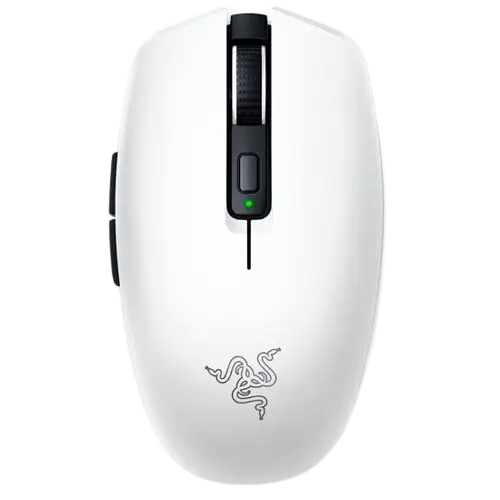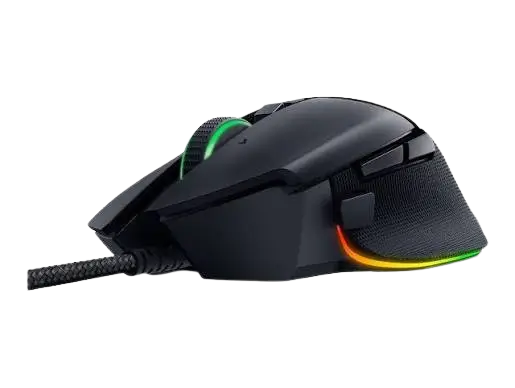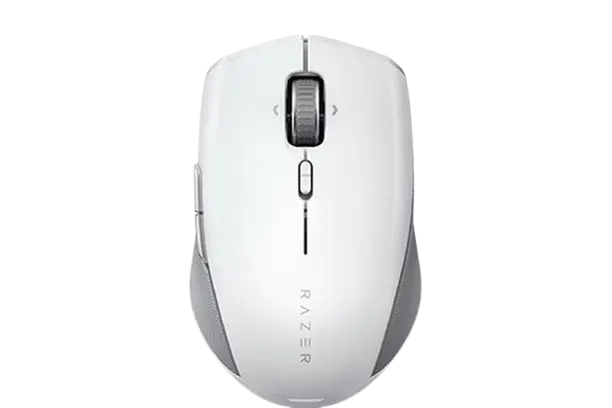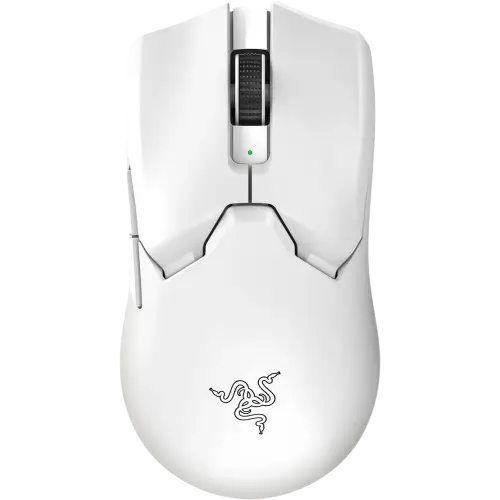
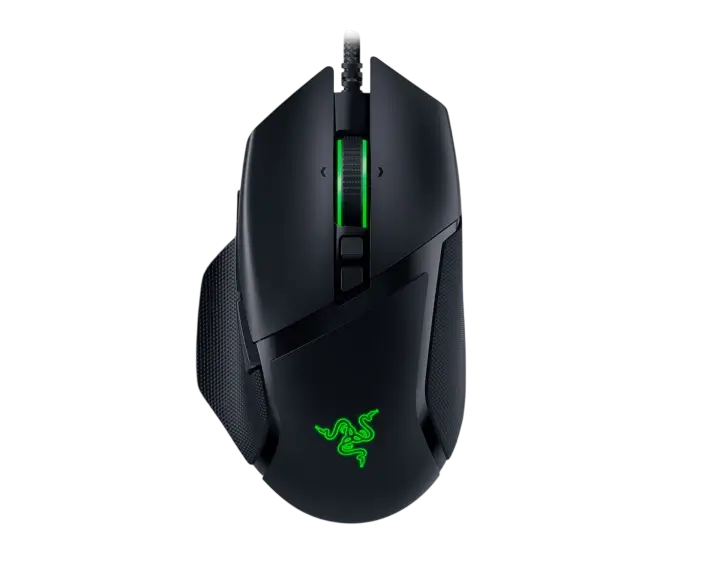
Razer Basilisk V2 Wired Gaming Mouse
The Razer Basilisk V2 is a right-handed wired gaming mouse with a Focus+ 20,000 DPI optical sensor, eleven independently programmable buttons and a scroll wheel with adjustable resistance. A replaceable multi-function paddle sits under the thumb and, by default, temporarily changes the mouse’s sensitivity while held down. The mouse connects with a 2.1 m / 7 ft Razer Speedflex cable. Button assignments, DPI stages, polling rate, lighting and surface calibration are set in Razer Synapse 3, and up to five profiles can be stored for use even on computers without Synapse 3.
Controls and Parts
Parts Identification
| Label | Part |
|---|---|
| A | Razer Speedflex Cable |
| B | Left mouse button |
| C | Right mouse button |
| D | Scroll wheel |
| E | Left tilt-click |
| F | Right tilt-click |
| G | DPI stage up |
| H | DPI stage down |
| I | Multi-function paddle |
| J | Mouse button 5 |
| K | Mouse button 4 |
| L | Ultraslick mouse feet |
| M | Scroll wheel resistance adjustment dial |
| N | Razer Focus+ 20,000 DPI Optical Sensor |
| O | Profile indicator |
| P | Profile button |
DPI Stages
The mouse supports up to five DPI stages that you move through with the DPI stage up (G) and DPI stage down (H) buttons. The stages start at 800 and 1800 (the default) and reach 20000 at the top, and you can customize them in Razer Synapse 3. Check your current stage values in Synapse 3 on the Performance subtab.
Key Specifications
| Specification | Detail |
|---|---|
| Sensor | True 20,000 DPI Focus+ optical sensor with 99.6% resolution accuracy |
| Tracking | Up to 650 inches per second (IPS) / 50 G acceleration |
| Lift-off/landing | Advanced lift-off/landing distance customization |
| Buttons | Eleven independently programmable buttons |
| Paddle | Replaceable multi-function paddle |
| Switches | Razer Optical Mouse Switches rated for 70M clicks |
| Design | Ergonomic right-handed design with textured side-grips |
| Scroll wheel | Gaming-grade tactile scroll wheel with infinitely customizable resistance |
| Sensitivity | On-The-Fly Sensitivity Adjustment |
| Storage | Hybrid on-board and cloud storage (4+1 profiles) |
| Software | Razer Synapse 3 enabled |
| Cable | 2.1 m / 7 ft Speedflex cable |
| Length | 130 mm / 5.11 in |
| Width | 60 mm / 2.36 in |
| Height | 42 mm / 1.65 in |
| Weight | 92 g / 3.3 oz (excluding cable) |
What You Need
The mouse needs a PC with a free USB port. To use Razer Synapse 3 you need Windows 7 64-bit (or higher) and an internet connection for the software installation.
Adjusting the Mouse
Scroll Wheel Resistance
Turn the scroll wheel resistance adjustment dial (M) on the underside to change the force needed to rotate the scroll wheel. The guide’s illustration shows the dial turned one way to increase resistance and the other way to decrease it, marked with + and − symbols.
Multi-Function Paddle
By default, holding the multi-function paddle down temporarily changes the mouse’s sensitivity. To make the paddle perform other tasks, install Razer Synapse 3. For a better fit, you can replace the paddle with other sizes, which are sold exclusively on razercarestore.razer.com.
Profile Button and Indicator
Press the profile button (P) to cycle through your stored profiles. The color of the profile indicator (O) shows which profile is selected:
| Profile | Designated color |
|---|---|
| Profile 1 | Red |
| Profile 2 | Green |
| Profile 3 | Blue |
| Profile 4 | Cyan |
The guide’s color table also lists White for “Active Profile.”
Customizing with Razer Synapse 3
Synapse and Mouse Tabs
The Synapse tab is the default tab when you first launch Razer Synapse 3, and its Dashboard subtab gives an overview of your Razer devices, modules and online services. The Mouse tab is the main tab for the Basilisk V2, where you change button assignment, DPI sensitivity and lighting.
Changes made under the Mouse tab are saved automatically to your system and cloud storage. To store profiles on the mouse’s on-board memory, click the Save button to open the storage slots, then drag and drop the profiles you want to store. The mouse can store up to 5 profiles from Synapse 3.
Profiles
A profile stores all of your Razer peripheral settings. By default, the profile name is based on your system’s name. To add, rename, duplicate or delete a profile, press the Miscellaneous button.
Button Assignments
The Customize subtab modifies the mouse’s button assignments. Click the Sidebar button to see all current assignments, or select a button on the Customize tab to jump to it. After selecting a button, you can assign one of these functions:
| Function | What it does |
|---|---|
| Default | Returns the button to its original setting |
| Keyboard Function | Turns the button into a keyboard function; optional Turbo mode emulates repeatedly pressing it while the button is held |
| Mouse Function | Substitutes another mouse function (left click, right click, scroll click, double click, mouse button 4 (browser back), mouse button 5 (browser forward), scroll up/down/left/right, repeat scroll up/down); Turbo mode is available for some |
| Sensitivity | Controls DPI from a button (see below) |
| Macro | Executes a prerecorded sequence of keystrokes and button presses with precise timing |
| Switch Profile | Loads a different profile’s button assignments; an on-screen notification appears when you switch |
| Switch Lighting | Switches from the current lighting effect to a custom lighting effect |
| Razer Hypershift | Activates Hypershift mode while the button is held |
| Launch Program | Opens an app or website; search for an app or enter a web address |
| Multimedia | Volume down/up, mute volume, mic volume up/down, mute mic, mute all, play/pause, previous track, next track |
| Windows 8 Charms | Assigns a Windows 8 shortcut command |
| Windows Shortcuts | Assigns a Windows operating system shortcut command |
| Text Function | Types prewritten text when the button is pressed, with full Unicode support |
| Disable | Makes the button unusable, for example if it interferes with your gaming |
The Sensitivity function offers these options:
- Sensitivity Clutch: Changes to a predefined DPI while the button is held; releasing it returns to the previous sensitivity.
- Sensitivity Stage Up / Down: Raises or lowers the current sensitivity by one stage.
- On-The-Fly Sensitivity: Press the button and move the scroll wheel up or down to raise or lower the current DPI.
- Cycle Up Sensitivity Stages: Raises the stage by one and returns to stage 1 after the highest stage.
- Cycle Down Sensitivity Stages: Lowers the stage by one and returns to the highest stage after stage 1.
Mouse Use and Hypershift
Mouse Use switches the orientation of your primary and secondary mouse functions for left-handed or right-handed users. Hypershift is a secondary set of button assignments that is active while the Hypershift key is held down. By default, the Hypershift key is the FN key of a Razer Synapse 3 supported keyboard, and you can also assign any mouse button as the Hypershift key.
Performance Settings
The Performance subtab controls sensitivity, acceleration and polling rate.
- Sensitivity: A higher DPI makes the cursor travel farther for the same mouse movement.
- Enable X-Y Sensitivity: By default the horizontal and vertical axes share one value. Select this option to set a different value for each axis. It can be used together with sensitivity stages.
- Sensitivity Stages: Create up to 5 preset sensitivity values to cycle through with the stage up/down buttons.
- Polling Rate: Choose 125Hz (8ms), 500Hz (2ms) or 1000Hz (1ms) from the dropdown. A higher rate means the computer receives mouse status updates more often.
- Mouse Properties: Opens the Windows Mouse Properties for operating system settings that can affect the mouse.
Lighting Settings
On the Lighting subtab, toggle Brightness to turn lighting off or use the slider to raise or lower luminance. Switch Off Lighting is a power-saving tool that can disable lighting when your system’s display turns off and/or power the mouse down automatically after it has been idle for a set time.
| Quick effect | Behavior | Setup |
|---|---|---|
| Audio Meter | LEDs light up according to the audio level, with a default spectrum of colors | Select a Color Boost level |
| Breathing | Lighting fades in and out of the selected color(s) | Select up to 2 colors or randomize |
| Reactive | LEDs light up when you click any mouse button | Select the color and how long the LED stays lit |
| Spectrum Cycling | LEDs cycle between 16.8 million colors indefinitely | No further customization required |
| Static | LEDs stay lit in the selected color | Select a color |
To synchronize quick effects with other supported Razer Chroma-enabled devices, click the Chroma Sync button. For Advanced Effects, press the Chroma Studio button to build your own Chroma effect.
Calibration
The Calibration subtab optimizes the sensor for your surface. Smart Tracking sets the distance at which the sensor stops tracking when lifted, to avoid unwanted cursor movement. Select Enable Asymmetric Cut-Off to set different lift-off and landing distances. For Manual Calibration, click Add A Surface, then choose a Razer mouse mat from the list or add your own.
Profiles Tab and Linked Games
On the Profiles tab, the Devices subtab shows which Razer device uses each profile. Click the add button to create a profile for the selected device, and use the Miscellaneous button to rename, duplicate or delete one. The Link Games option activates a profile automatically when you run an application. The Linked Games subtab lets you add games, view peripherals linked to games and search added games, and sort by alphabetical order, last played or most played. Added games stay listed even if not linked to a Razer device.
Settings Window
Click the settings button in Razer Synapse 3 to open the Settings window. The General tab sets display language and start-up behavior and lets you view the master guide of connected Razer devices. The Reset tab performs a factory reset, which erases all profiles stored in the selected device’s on-board memory. On devices without on-board memory, a factory reset only creates a new Synapse 3 profile with default settings. The About tab shows software information and terms-of-use links, checks for software updates and links to Razer’s social communities.
Safety, Care and Comfort
Safety Guidelines
- If you have trouble operating the mouse and troubleshooting does not work, unplug it and contact the Razer hotline or go to support.razer.com. Do not attempt to service or fix the device yourself at any time.
- Do not take the device apart. Doing so voids your warranty. Do not attempt to operate it under abnormal current loads.
- Keep the device away from liquid, humidity and moisture.
- Operate the device only within 0°C (32°F) to 40°C (104°F). If the temperature goes outside this range, unplug and/or switch off the device and let the temperature stabilize.
Cleaning and Surface Care
Once a month, unplug the mouse from the computer and clean it with a soft cloth or cotton swab to prevent dirt buildup. Do not use soap or harsh cleaning agents.
For the best movement and control, Razer recommends a premium Razer mouse mat. The sensor is tuned and optimized for Razer mouse mats, and Razer states it has been tested to track best on them. Some surfaces cause undue wear on the mouse feet, which then need constant care and eventual replacement.
Comfort Guidelines
Long periods of repetitive motion, poor peripheral positioning, incorrect body position and poor habits may be associated with physical discomfort and injury to nerves, tendons and muscles. To reduce the risk:
- Position your keyboard and monitor directly in front of you with the mouse next to the keyboard. Keep your elbows at your sides, not too far away, and the keyboard within easy reach.
- Adjust your chair and table height so the keyboard and mouse are at or below elbow height.
- Keep your feet well supported, your posture straight and your shoulders relaxed.
- During gameplay, relax your wrist and keep it straight. For repeated tasks, avoid bending, extending or twisting your hands for long periods.
- Do not rest your wrists on hard surfaces for long periods. Use a wrist rest to support your wrist while gaming.
- Customize the keys on your keyboard to suit your style of gaming and minimize repetitive or awkward motions.
- Do not sit in one position all day. Get up, step away from your desk and stretch your arms, shoulders, neck and legs.
If you feel pain, numbness or tingling in your hands, wrists, elbows, shoulders, neck or back, consult a qualified medical doctor immediately.
Warranty, Registration and Support
The Razer Basilisk V2 comes with a 2-year limited warranty. Registering at razerid.razer.com unlocks exclusive Razer benefits. The serial number is on the underside of the mouse, in the S/N area marked in the guide’s illustration. For the latest warranty terms, visit razer.com/warranty.
Frequently Asked Questions
How do I adjust the scroll wheel resistance on the Razer Basilisk V2?
Turn the scroll wheel resistance adjustment dial on the underside of the mouse. Turning it one way makes the wheel harder to rotate and turning it the other way makes it easier, as shown by the + and − marks in the guide’s illustration. No software is needed for this adjustment.
What does the multi-function paddle do, and can I replace it?
By default, holding the paddle down temporarily changes the mouse’s sensitivity. To make it do something else, install Razer Synapse 3 and reassign it there. You can also swap it for another size for a better fit; replacement paddles are sold exclusively on razercarestore.razer.com.
How do I change the DPI on the Razer Basilisk V2?
Press the DPI stage up or DPI stage down button to move between your sensitivity stages. In Razer Synapse 3, open Mouse > Performance to create up to 5 sensitivity stages and set their values, and use the Customize subtab if you want to assign Sensitivity Clutch, On-The-Fly Sensitivity or stage cycling to another button. With On-The-Fly Sensitivity, you press the assigned button and move the scroll wheel up or down to raise or lower the DPI.
How do I switch profiles, and what do the indicator colors mean?
Press the profile button on the underside to cycle through your stored profiles. The profile indicator color shows which one is selected: red for Profile 1, green for Profile 2, blue for Profile 3 and cyan for Profile 4. To store profiles on the mouse itself, open the Mouse tab in Synapse 3, click the Save button and drag the profiles you want into the on-board memory slots. The mouse stores up to 5 profiles, and you can use them even on a computer that doesn’t have Synapse 3 installed.
What do I need to use Razer Synapse 3 with the Basilisk V2?
You need Windows 7 64-bit (or higher), a PC with a free USB port for the mouse, and an internet connection to install the software. Synapse 3 is what lets you reassign buttons, edit DPI stages, change polling rate and lighting, and calibrate the sensor.
How do I change the polling rate?
Open Razer Synapse 3, go to Mouse > Performance and choose a value from the Polling Rate dropdown: 125Hz (8ms), 500Hz (2ms) or 1000Hz (1ms). A higher polling rate means the computer receives information about the mouse more often.
How do I reassign a button or create a macro?
In Synapse 3, open Mouse > Customize and select the button you want to change. You can assign a keyboard function, another mouse function, a sensitivity control, a macro, a profile or lighting switch, Hypershift, a program or website launcher, multimedia controls, Windows shortcuts, typed text or Disable. Select Default on any button to return it to its original setting. A macro is a prerecorded sequence of keystrokes and button presses executed with precise timing.
What is Hypershift mode?
Hypershift is a second set of button assignments that becomes active only while the Hypershift key is held down. The key defaults to FN on a Razer Synapse 3 supported keyboard, but you can assign any mouse button to it by choosing Razer Hypershift as that button’s function.
How do I stop the sensor from moving the cursor when I lift the mouse?
In Synapse 3, go to Mouse > Calibration and use Smart Tracking to set the distance at which the sensor stops tracking after you lift the mouse. Select Enable Asymmetric Cut-Off if you want separate lift-off and landing distances. For a closer match to your mouse pad, use Manual Calibration, click Add A Surface, and pick your Razer mouse mat from the list or add your own.
How do I factory reset the Razer Basilisk V2?
Open the Settings window in Razer Synapse 3 and go to the Reset tab. Resetting erases all profiles stored on the selected device’s on-board memory, so move anything you want to keep first. On devices without on-board memory, a reset only creates a new Synapse 3 profile with default settings.
How should I clean the Razer Basilisk V2, and what temperatures is it rated for?
Once a month, unplug the mouse and wipe it with a soft cloth or cotton swab. Do not use soap or harsh cleaning agents, and keep the mouse away from liquid, humidity and moisture. Use it only between 0°C (32°F) and 40°C (104°F); if it goes outside that range, unplug or switch it off until the temperature stabilizes.