| Field | Details |
| Document Title | IMI Heatmiser neoStat 12V V3 Smart Thermostat User Manual |
| Document Type | User Manual |
| Brand Name | IMI Heatmiser |
| Product Name | neoStat 12V Smart Thermostat |
| Model Number(s) | neoStat 12V V3 |
| PDF File Size | 517.5 KiB |
| Total Number of Pages | 40 |
| Languages Covered | English |
IMI Heatmiser Smart Thermostat neoStat 12V V3
The IMI Heatmiser neoStat 12V V3 is a smart programmable thermostat designed to control heating systems using a 12V DC supply. It provides room temperature regulation, programmable heating schedules, temperature sensor selection, frost protection, holiday settings, and time clock operation.
The neoStat 12V V3 supports two main operating modes: Thermostat Mode (Mode 1) and Time Clock Mode (Mode 2). Thermostat Mode controls heating according to temperature settings, while Time Clock Mode operates a timed output according to programmed ON and OFF periods.
The thermostat can connect to a Heatmiser neoHub, allowing communication through the neo mesh network and integration with the Heatmiser neoApp. It is also designed for connection to the Heatmiser UH8-N wiring center, which supports up to eight 12V thermostats or timers.
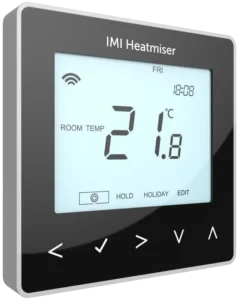
The neoStat features an LCD screen, five touch-sensitive navigation buttons, an approach sensor, programmable comfort levels, temperature hold, keypad locking, and multiple temperature sensor configurations.
Important: The neoStat 12V V3 must not be used to control electric underfloor heating.
Product Overview and Technical Specifications
The neoStat 12V V3 combines programmable temperature control with wired low-voltage operation and optional neoHub connectivity.
| Specification | Details |
| Brand | IMI Heatmiser |
| Model | neoStat 12V V3 |
| Product Series | neo Series |
| Product Type | Smart Programmable Thermostat |
| Operating Supply | 12V DC |
| Display | LCD |
| Controls | Five touch-sensitive navigation keys |
| Approach Sensor | Supported |
| Installation Type | Flush-mounted |
| Minimum Back Box Depth | 35 mm |
| Operating Modes | Mode 1: Thermostat; Mode 2: Time Clock |
| Default Operating Mode | Thermostat |
| Programming Modes | Weekday/Weekend, 7 Day, 24 Hour, Non-Programmable |
| Default Programming Mode | Weekday/Weekend |
| Comfort Levels | Four per programmed day or day group |
| Temperature Units | Celsius (°C) or Fahrenheit (°F) |
| Temperature Sensors | Built-in air, remote air, floor, or combined configurations |
| Supplied Floor Probe | 10K |
| Compatible Floor Probe Values | 10K, 12K, 15K |
| Frost Protection Range | 7–17°C |
| Default Frost Temperature | 12°C |
| Switching Differential | 0.5°C, 1°C, 2°C, or 3°C |
| Default Switching Differential | 1°C |
| Output Delay | 0–15 minutes |
| Floor Temperature Limit | 20–45°C |
| Default Floor Limit | 28°C |
| Optimum Start | 0–5 hours |
| Keypad Lock | Four-digit PIN |
| Temperature Hold | Supported |
| Holiday Mode | Supported |
| neoHub Pairing | Supported |
| UH8-N Compatibility | Supported |
| UH8-N Capacity | Up to eight 12V thermostats/timers |
| Recommended Network Cable | CAT5-FTP or BELDEN 9538 |
| Radio Frequency | 2.4 GHz |
| RF Output Power | 3.54 dBm |
Understanding the Programmable Room Thermostat
The neoStat 12V V3 combines a heating programmer with a room thermostat.
The thermostat monitors the room temperature and requests heating when the measured temperature falls below the selected target temperature.
Once the target temperature is reached, the thermostat stops requesting heat.
The programming function allows different temperatures to be maintained at selected times throughout the day.
How Temperature Settings Affect Heating
Setting the thermostat to a higher temperature does not make a room heat up faster. The heating speed depends on the design and size of the heating system.
A higher target temperature causes the heating system to continue operating until the higher temperature is reached.
Reducing the temperature setting also does not make the room cool faster. It changes the temperature the thermostat is instructed to maintain.
Choosing a Comfortable Temperature
A suitable way to establish a comfortable heating temperature is to begin with a lower setting, such as 18°C, and increase it gradually by 1°C each day until the desired comfort level is achieved.
Once a comfortable temperature has been established, the programmed schedule can maintain it automatically.
Thermostat Location and Temperature Accuracy
The thermostat requires normal airflow around its temperature sensor.
It should not be covered by curtains or blocked by furniture.
Nearby electrical heaters, televisions, and lamps can affect the temperature reading and interfere with heating control.
Parts, Controls, and Components
The neoStat 12V V3 includes an LCD display, five navigation keys, a removable front panel, and a back plate for installation.
The thermostat also supports connections for remote temperature sensors and the UH8-N wiring center.
Main Components
| Component | Function |
| LCD Display | Shows temperature, time, operating mode, and status indicators. |
| Touch Navigation Keys | Used to change settings and operate the thermostat. |
| Approach Sensor | Activates the display backlight and touch-key illumination when approached. |
| Front Panel | Houses the display and controls. |
| Back Plate | Secures the thermostat to the recessed wall back box. |
| Retaining Screw | Secures the front panel to the back plate. |
| Terminal Connections | Provide connections for the 12V DC supply, control wiring, and optional sensors. |
| Floor Temperature Probe | Measures floor temperature when configured for floor sensing. |
| Remote Air Sensor Connection | Allows a compatible remote air probe to be connected. |
Touch Control Buttons
| Button | Function |
| Left Arrow (◀) | Moves left through menu options and selections. |
| Tick / Confirm (✓) | Opens highlighted functions, confirms settings, and activates selected controls. |
| Right Arrow (▶) | Moves right through menus and programming options. |
| Down Arrow (▼) | Decreases temperature, time, or other adjustable values. |
| Up Arrow (▲) | Increases temperature, time, or other adjustable values. |
Some functions require the Tick button to be held for several seconds.
Approach Sensor
The neoStat 12V V3 includes an approach sensor that detects when someone moves toward the thermostat.
When a person approaches, the touch-sensitive keys and LCD backlight illuminate.
This allows the thermostat controls and display to be seen more easily in a dark room.
Installation Instructions
The neoStat 12V V3 is designed for flush mounting into a recessed wall back box.
A minimum back box depth of 35 mm is required.
Important Installation Precautions
- Mount the thermostat at eye level.
- Avoid installing it near a direct heat source.
- Do not press forcefully on the LCD screen, as permanent damage may occur.
- Follow the correct wiring diagram for the selected operating mode.
- Electrical installation must be performed by a qualified electrician.
- The installation must comply with local electrical regulations.
Step 1: Remove the Front Panel
- Locate the retaining screw on the bottom edge of the thermostat.
- Use a small screwdriver to loosen the screw slightly.
- Carefully separate the front section from the back plate.
- Place the front panel somewhere safe.
Step 2: Connect the Wiring
The electrical wiring must follow the relevant manufacturer’s diagram.
- For Thermostat Mode, use the diagram on printed manual page 29.
- For Time Clock Mode, use the diagram on printed manual page 36.
These are PDF pages 30 and 37 respectively.
Step 3: Secure the Back Plate
- Position the thermostat back plate against the recessed back box.
- Align the fixing holes.
- Screw the back plate securely into the back box.
Step 4: Reattach the Front Panel
- Position the thermostat front panel against the installed back plate.
- Carefully clip the front section into place.
- Tighten the retaining screw to secure the assembly.
The installation procedure is illustrated on PDF pages 6–7.
Selecting the Operating Mode
The neoStat 12V V3 provides two operating modes.
| Mode | Function |
| Mode 1 | Programmable Thermostat |
| Mode 2 | Time Clock |
Thermostat Mode is the factory default.
Mode 1: Thermostat
Mode 1 controls heating according to measured temperature and the configured target temperature.
It supports manual temperature adjustment, programmable comfort levels, Temperature Hold, Frost Protection, and Holiday Mode.
Mode 2: Time Clock
Mode 2 operates the timed output according to programmed ON and OFF switching periods.
It supports scheduled switching times and temporary timer override.
How to Change the Operating Mode
- Use Left and Right to highlight the Power symbol.
- Press and hold Tick for 3 seconds.
- SETUP will be highlighted.
- Press and hold Tick for 10 seconds.
- Use Left and Right to select the required mode.
- Select 1 for Thermostat Mode or 2 for Time Clock Mode.
- Press Tick to confirm.
The thermostat returns to the main display for the selected operating mode.
The same setup sequence is also used during factory reset, so stored configuration and pairing settings may need to be configured again after the operation.
Pairing the neoHub
The neoStat 12V V3 can communicate with a compatible Heatmiser neoHub through the neo mesh network.
The neoHub must first be connected to the router and registered using the Heatmiser neoApp.
Step 1: Connect the neoHub
- Connect the neoHub to the router using the supplied Ethernet cable.
- Connect the neoHub power supply.
- Wait for the router to assign an IP address to the neoHub.
The Link LED turns red when the neoHub connects to the local network.
Once the neoHub connects to the Heatmiser cloud server, the Link LED turns green.
Step 2: Set Up the neoApp
- Connect the smartphone or tablet to the same Wi-Fi network as the router.
- Download the Heatmiser neoApp from the Apple App Store or Google Play Store.
- Register an account.
- Sign in to the app.
- Select Add Location.
- Press the Connect button on the neoHub when prompted.
- After the hub connects successfully, enter a name for the location, such as Home.
Step 3: Add the neoStat 12V V3
Once the neoHub has been paired with the account:
- Select ADD NEOSTAT in the app.
- Enter a preset or custom name for the thermostat.
- Press NEXT.
- The app allows two minutes for the neoStat to join the neoHub.
Step 4: Activate Pairing on the Thermostat
- Use Left and Right to highlight the Power symbol.
- Press and hold Tick.
- SETUP will be highlighted.
- Press Tick once to open the setup menu.
- Feature 01 appears.
- Press Tick again to activate pairing.
The mesh icon begins flashing.
When the neoStat successfully connects to the neoHub, the mesh icon remains continuously displayed.
Step 5: Complete the Pairing
In the neoApp:
- Select ADD ANOTHER to add another thermostat.
- Select FINISH to complete the setup.
The neoHub only needs to be paired with the account once.
Additional neoStats can be added through the ZONES section using EDIT and ADD ZONE.
Understanding the Mesh Network
The neoStat uses mesh network communication.
Compatible neoStats can send and receive communication through other thermostats on the network.
The signal can be relayed between devices until it reaches its destination.
This communication arrangement extends the network range and improves communication stability compared with conventional radio-frequency thermostat connections.
Mesh Connection Indicator
The mesh symbol appears when the thermostat is communicating with the neoHub.
If the mesh symbol disappears, the connection to the neoHub has been lost.
Mode 1: Programmable Thermostat
Mode 1 provides temperature-based heating control.
The thermostat can maintain a selected temperature manually or follow programmed comfort levels throughout the day.
The available functions include:
- Room temperature control
- Programmable heating schedules
- Manual temperature adjustment
- Temperature Hold
- Frost Protection
- Holiday Mode
- Temperature sensor selection
- Floor temperature limiting
- Optimum Start
- Keypad locking
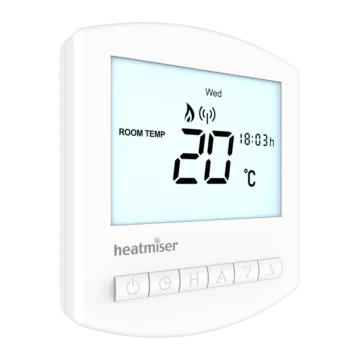
Thermostat LCD Display
The LCD provides information about the current temperature, active heating demand, programmed schedule, and operating status.
LCD Display Symbols
| Display Indicator | Meaning |
| Mesh Symbol | Indicates connection to the neoHub. |
| Day Indicator | Displays the current day of the week. |
| Frost Protection Symbol | Indicates that frost protection is active. |
| Flame Symbol | Indicates a heating demand. |
| Flashing Flame Symbol | Indicates that Optimum Start is operating. |
| Holiday Symbol | Indicates Holiday Mode. |
| Floor Limit Symbol | Appears when the floor probe reaches the configured temperature limit. |
| FLOOR TEMP / ROOM TEMP | Identifies the displayed temperature sensor. |
| SET | Appears when changing the set temperature or other settings. |
| Program Indicator | Identifies the programmed comfort level being edited. |
| Main Menu | Highlights the selected menu function. |
| Keypad Lock Symbol | Indicates that the keypad is locked. |
| Temperature Display | Displays the measured sensor temperature. |
| °C / °F | Shows the selected temperature unit. |
| HOLD LEFT | Displays the remaining time of an active temperature hold. |
| Time / Date | Displays clock, calendar, and holiday information. |
Temperature Sensor Display
The neoStat 12V V3 can display temperature readings from different sensor configurations.
Available configurations include the built-in air sensor, remote air sensor, floor sensor, or combined air and floor sensors.
Room Temperature
When the thermostat uses an air temperature sensor, the display identifies the reading as ROOM TEMP.
Floor Temperature
When the floor sensor is used, the display identifies the reading as FLOOR TEMP.
Viewing Floor Temperature With Combined Sensors
When both air and floor sensors are enabled, the room temperature appears by default.
To view the floor temperature:
- Press and hold Left and Right together.
- Continue holding for 5 seconds.
- The floor temperature appears on the display.
The FLOOR TEMP label identifies the reading.
Setting the Clock and Calendar
The thermostat uses the date and time to operate heating schedules and holiday settings.
How to Set the Clock
- Use Left and Right to highlight the Power symbol.
- Press and hold Tick to turn off the display.
- Use Right to select CLOCK.
- Press Tick.
- Use Up and Down to select the year.
- Press Tick to confirm.
- Select the month using Up and Down.
- Press Tick.
- Repeat the procedure for the date and time.
- Press Tick to save the clock settings.
- Use Down to highlight the Power symbol.
- Press Tick to turn the display on.
Heating Programs and Comfort Levels
The neoStat 12V V3 supports programmable heating schedules using four comfort periods:
- WAKE
- LEAVE
- RETURN
- SLEEP
Each period has a selected starting time and target temperature.
Programming Modes
| Programming Mode | Description |
| Weekday/Weekend | Four comfort levels for Monday–Friday and four separate levels for Saturday–Sunday. |
| 7 Day | Each day has four independently configurable comfort levels. |
| 24 Hour | The same comfort levels apply every day. |
| Non-Programmable | Manual temperature control without a timed schedule. |
When the thermostat is connected to the mesh network, the system programming mode is configured through the neoApp.
Default Heating Schedule
The neoStat is supplied with the following programmed comfort levels.
| Comfort Period | Time | Temperature |
| WAKE | 07:00 | 21°C |
| LEAVE | 09:00 | 16°C |
| RETURN | 16:00 | 21°C |
| SLEEP | 22:00 | 16°C |
These settings can be changed to suit the required heating schedule.
How to Program Comfort Levels
- Use Left and Right to highlight EDIT.
- Press Tick.
- Use Left and Right to select the day or day group.
- Press Tick.
- WAKE flashes and the current time and temperature appear.
- Press Tick to edit WAKE.
- Use Up and Down to set the hour.
- Press Tick.
- Use Up and Down to set the minutes.
- Press Tick.
- Use Up and Down to select the required temperature.
- Press Tick.
- Press Right to move to LEAVE.
- Press Tick to edit the LEAVE settings.
- Repeat the procedure for RETURN and SLEEP.
- Highlight DONE and press Tick to save the changes.
Weekday/Weekend Programming
This mode uses one set of comfort levels for Monday through Friday and another for Saturday and Sunday.
7 Day Programming
In 7 Day Mode, each day can have its own four comfort levels.
24 Hour Programming
In 24 Hour Mode, the same four comfort levels repeat every day.
Disabling Unused Comfort Periods
An unused comfort period can be skipped by setting its time to –:–.
The thermostat ignores the disabled period.
Manual Temperature Control
The required temperature can be changed directly using the Up and Down keys.
How to Change the Set Temperature
- Press Up or Down.
- SET appears with the target temperature.
- Use Up and Down to adjust the required temperature.
- Press Tick to confirm and return to the main display.
When a programmed schedule is active, the adjusted temperature remains in effect until the next comfort period begins.
At that point, the thermostat returns to the programmed temperature.
Temperature Hold Function
Temperature Hold temporarily overrides the heating schedule and maintains a selected temperature for a specified duration.
How to Set Temperature Hold
- Use Left and Right to highlight HOLD.
- Press Tick.
- Use Up and Down to select the required hold duration.
- Press Tick.
- Use Up and Down to select the required hold temperature.
- Press Tick to confirm.
HOLD LEFT appears on the display with the remaining time.
The countdown continues until the hold period ends.
When the countdown finishes, the thermostat returns to its normal program.
How to Cancel Temperature Hold
- Highlight HOLD.
- Press Tick.
- When CANCEL is highlighted, press Tick again.
The hold is canceled.
Locking and Unlocking the Thermostat
The neoStat includes a four-digit PIN keypad lock.
How to Lock the Keypad
- Use Left and Right to highlight HOLD.
- Press and hold Tick for 10 seconds.
- The display shows 0000.
- Use Up and Down to enter the first two PIN digits.
- Press Tick.
- Use Up and Down to enter the final two digits.
- Press Tick.
The thermostat returns to the main screen and displays the keypad lock symbol.
How to Unlock the Keypad
- Press Tick once.
- The display shows 00:00.
- Enter the first two digits of the PIN using Up and Down.
- Press Tick.
- Enter the final two digits.
- Press Tick.
The keypad unlocks and returns to the main display.
Frost Protection Mode
Frost Protection allows the thermostat to maintain a reduced temperature when normal heating operation is not required.
How to Activate Frost Protection
- Use Left and Right to highlight the Power symbol.
- Press Tick once.
The frost protection icon appears.
Heating is requested only when the measured room temperature falls below the configured frost protection temperature.
If heating becomes active, the flame symbol appears.
How to Cancel Frost Protection
- Highlight the Power symbol.
- Press Tick once.
The frost protection icon disappears.
Frost Protection Temperature Settings
| Setting | Value |
| Minimum | 7°C |
| Maximum | 17°C |
| Default | 12°C |
The frost protection temperature can be changed through optional Feature 03.
Turning the Thermostat On and Off
Turning the Thermostat Off
- Highlight the Power symbol.
- Press and hold Tick for approximately 3 seconds.
- The display turns off.
The display and heating output are switched off.
Turning the Thermostat On
Press Tick once.
The thermostat returns to its main operating display.
Heating Demand Indicator
When the flame icon is visible, the thermostat is requesting heat.
When the flame icon is absent, there is no current heating demand to achieve the target temperature.
The thermostat remains active unless it has been switched off.
Holiday Mode
Holiday Mode maintains the frost protection temperature for a selected period.
At the end of the holiday, the thermostat automatically returns to its normal programmed operation.
In Time Clock Mode, the holiday function keeps the timed output off.
How to Activate Holiday Mode
- Use Left and Right to highlight HOLIDAY.
- Press Tick.
- Use Up and Down to select the year in which the holiday ends.
- Press Tick.
- Select the month.
- Press Tick.
- Repeat the procedure for the ending date and time.
- Press Tick to confirm.
The holiday period begins immediately.
The thermostat returns to normal operation at the configured ending date and time.
How to Cancel Holiday Mode
- Highlight HOLIDAY.
- Press Tick.
- When CANCEL is highlighted, press Tick again.
Advanced Thermostat Settings
The neoStat 12V V3 includes optional settings for heating response, sensor selection, floor temperature limiting, and programming configuration.
How to Open the Optional Settings
- Use Left and Right to highlight the Power symbol.
- Press and hold Tick for 3 seconds.
- SETUP will be highlighted.
- Press Tick once.
- The feature number and setting value appear.
- Use Up and Down to select the required feature.
- Use Left and Right to change the setting.
- Press Tick to confirm and exit.
Optional Features Reference Table
| Feature | Description | Available Settings |
| 01 | neoHub Pairing | Used to add the thermostat to the neoHub |
| 02 | Switching Differential | 0.5°C, 1°C, 2°C, 3°C; Default: 1°C |
| 03 | Frost Protection Temperature | 7–17°C; Default: 12°C |
| 04 | Output Delay | 0–15 minutes; Default: 0 |
| 05 | Temperature Up/Down Limit | 0–10°C; Default: 0 |
| 06 | Sensor Selection | Built-in air, remote air, floor, or combined sensors |
| 07 | Floor Temperature Limit | 20–45°C; Default: 28°C |
| 08 | Optimum Start | 0–5 hours; Default: 0 |
| 09 | Rate of Change | Minutes required to increase temperature by 1°C |
| 10 | Not Used | — |
| 11 | Not Used | — |
| 12 | Programming Mode | Non-Programmable, Weekday/Weekend, 7 Day, 24 Hour |
| 13 | Temperature Format | 00 = °C; 01 = °F; Default: °C |
Feature 01: neoHub Pairing
Feature 01 allows the thermostat to connect to a Heatmiser neoHub.
The mesh icon flashes during pairing and remains displayed after a successful connection.
Feature 02: Switching Differential
Switching Differential determines how far the measured temperature must fall below the target temperature before heating starts.
For example, with a target temperature of 20°C:
- A 1°C differential activates heating at 19°C and stops it at 20°C.
- A 2°C differential activates heating at 18°C and stops it at 20°C.
The default is 1°C.
Feature 03: Frost Protection Temperature
This setting determines the temperature maintained during Frost Protection Mode.
The available range is 7–17°C.
The default is 12°C.
Feature 04: Output Delay
Output Delay prevents rapid switching of the heating output.
The adjustable range is 0–15 minutes.
The default is 0, meaning no delay is applied.
Feature 05: Temperature Adjustment Limit
This feature restricts manual temperature changes using the Up and Down keys.
The limit also applies when the thermostat is locked, allowing restricted adjustment.
The setting range is 0–10°C.
Feature 06: Temperature Sensor Selection
The neoStat supports different sensor configurations.
| Setting | Sensor Mode |
| 00 | Built-in Air Sensor (Default) |
| 01 | Remote Air Sensor |
| 02 | Floor Sensor Only |
| 03 | Built-in Air and Floor Sensor |
| 04 | Remote Air and Floor Sensor |
When both an air sensor and floor sensor are enabled, the floor sensor is used to limit the floor temperature.
Feature 07: Floor Temperature Limit
The floor temperature limit is available when Sensor Selection is configured as 03 or 04.
The adjustable range is 20–45°C.
The factory default is 28°C.
The floor sensor provides a limiting function intended to prevent excessive floor temperature.
Important: The neoStat 12V V3 must not be used to control electric underfloor heating.
Feature 08: Optimum Start
Optimum Start calculates when heating should begin so that the selected temperature can be reached at the programmed time.
The thermostat uses the measured heating rate to estimate the required start time.
The setting range is 0–5 hours.
The default is 0.
Feature 09: Rate of Change
Rate of Change represents the number of minutes the thermostat calculates are required to increase the temperature by 1°C.
For example, a value of 20 represents an estimated 20 minutes to raise the temperature by 1°C.
This information is used by Optimum Start.
Feature 12: Programming Mode
The available settings are:
| Setting | Programming Mode |
| 00 | Non-Programmable |
| 01 | Weekday/Weekend (Default) |
| 02 | 7 Day |
| 03 | 24 Hour |
Feature 13: Temperature Format
The temperature display can be changed between Celsius and Fahrenheit.
- 00: Celsius
- 01: Fahrenheit
Celsius is the factory default.
Floor Temperature Sensor Probe Type
The neoStat 12V V3 is supplied with a 10K floor temperature sensor probe.
It is also compatible with 12K and 15K floor sensor probes.
Compatible Probe Values
| Setting | Probe Type |
| 10 | 10K |
| 12 | 12K |
| 15 | 15K |
How to Change the Floor Probe Type
- Use Left and Right to highlight the Power symbol.
- Press and hold Tick to turn off the display.
- Press and hold Up and Down together for 5 seconds.
- The probe selection screen appears.
- Use Left and Right to select 10, 12, or 15.
- Press Tick to confirm.
The thermostat returns to its main display with the selected probe type configured.
Important: The manufacturer specifies that this procedure should only be performed by an experienced technician who has accurately verified the connected probe value.
Recalibrating the Thermostat
The neoStat 12V V3 provides a temperature recalibration procedure.
How to Recalibrate the Temperature
- Use Left and Right to highlight the Power symbol.
- Press and hold Tick to switch off the display.
- Press and hold Tick and Down together for 10 seconds.
- The current temperature appears.
- Use Up and Down to select the new calibration temperature.
- Press Tick to confirm.
- The display turns off.
- Use Down to highlight the Power symbol.
- Press Tick to turn the thermostat back on.
neoStat 12V V3 Thermostat Wiring Diagram
The Thermostat Mode wiring diagram is located on PDF page 30 (printed manual page 29).
It illustrates the 12V DC supply, control terminals, optional temperature probes, and connection to the Heatmiser UH8-N wiring center.
Terminal Identification
| Terminal | Connection or Function |
| RT2 | Remote air probe connection |
| RT1 | Floor temperature probe connection |
| – | Negative supply and common probe connection as illustrated |
| A2 | Control connection to the corresponding UH8-N terminal |
| A1 | Control connection to the corresponding UH8-N terminal |
| + | Positive 12V DC supply connection |
The wiring diagram shows the corresponding +, A1, A2, and – connections between the thermostat and UH8-N.
Connecting to the UH8-N
The Heatmiser UH8-N allows connection of up to eight 12V thermostats or timers.
The manufacturer specifies the following cabling when connecting network devices:
- CAT5-FTP
- BELDEN 9538
The cable screen must be connected to S (Earth) at the UH8-N.
Optional Floor and Remote Air Probes
The Thermostat Mode wiring diagram shows an optional floor probe and optional remote air probe.
The floor probe connects through RT1 and the shared sensor connection.
The remote air probe connects through RT2 and the shared sensor connection.
The wiring arrangement is illustrated on PDF page 30.
The electrical connections must be completed by a qualified electrician in accordance with the manufacturer’s wiring diagram and applicable local regulations.
Mode 2: Time Clock
Mode 2 allows the neoStat 12V V3 to operate as a programmable time clock rather than a temperature-controlled thermostat.
The time clock switches its output according to selected ON and OFF times.
It supports Weekday/Weekend, 7 Day, and 24 Hour programming.
Time Clock Display Indicators
| Indicator | Function |
| Mesh Symbol | Indicates connection to the neoHub. |
| Day Indicator | Displays the current day. |
| Holiday Symbol | Indicates Holiday Mode. |
| SET | Appears when changing settings. |
| Program Indicator | Identifies the switching period being edited. |
| Main Menu | Highlights the selected function. |
| Keypad Lock Symbol | Indicates that the keypad is locked. |
| TIMER ON / TIMER OFF | Shows the current timed output status. |
| HOLD LEFT | Displays the remaining timer override duration. |
| Time / Date | Displays clock, calendar, and holiday information. |
Programming the Time Clock
The time clock provides four switching periods per programmed day or day group.
Each period contains an ON time and an OFF time.
How to Set Switching Times
- Use Left and Right to highlight EDIT.
- Press Tick.
- Use Left and Right to select the day or day group.
- Press Tick.
- Switching period 1 flashes, and its ON time appears.
- Press Down to view the existing OFF time if required.
- Select the switching period and press Tick.
- Use Up and Down to set the ON hour.
- Press Tick.
- Use Up and Down to set the ON minutes.
- Press Tick.
- Use Up and Down to set the OFF hour.
- Press Tick.
- Use Up and Down to set the OFF minutes.
- Press Tick.
- Press Right to move to switching period 2.
- Repeat the procedure for the remaining periods.
- Highlight DONE and press Tick to save the changes.
Switching Periods
| Period | Settings |
| Period 1 | ON time and OFF time |
| Period 2 | ON time and OFF time |
| Period 3 | ON time and OFF time |
| Period 4 | ON time and OFF time |
Disabling Unused Switching Periods
Set an unused switching period to –:–.
The time clock ignores the unused period.
Time Clock Programming Modes
The time clock supports three programming modes.
| Setting | Programming Mode |
| 01 | Weekday/Weekend (Default) |
| 02 | 7 Day |
| 03 | 24 Hour |
Weekday/Weekend Programming
This mode provides four ON/OFF switching periods for Monday through Friday and four separate periods for Saturday and Sunday.
7 Day Programming
Each day can have four independently programmed ON/OFF switching periods.
24 Hour Programming
The same switching schedule repeats every day.
Time Clock Optional Settings
| Feature | Description |
| 01 | neoHub Pairing |
| 02 | Programming Mode |
Feature 01 is used to connect the time clock to the neoHub.
Feature 02 selects Weekday/Weekend, 7 Day, or 24 Hour programming.
Timer Override
Timer Override allows the timed output to be switched on for a selected duration.
How to Activate Timer Override
- Use Up and Down to select the required override duration.
- For example, select 02:00 for a two-hour override.
- Press Tick to confirm.
The display shows HOLD LEFT and the remaining time.
TIMER ON appears while the timed output is active.
Holiday Mode in Time Clock Operation
In Time Clock Mode, Holiday Mode keeps the timed output off for the selected holiday period.
At the end of the holiday, the time clock returns to its programmed operation.
How to Activate Holiday Mode
- Highlight HOLIDAY.
- Press Tick.
- Use Up and Down to select the holiday ending year.
- Press Tick.
- Select the month.
- Press Tick.
- Set the ending date and time.
- Press Tick to confirm.
The holiday begins immediately.
How to Cancel Holiday Mode
- Highlight HOLIDAY.
- Press Tick.
- When CANCEL is highlighted, press Tick again.
Time Clock Mode Wiring Diagram
The Time Clock Mode wiring diagram is located on PDF page 37 (printed manual page 36).
It illustrates the neoStat 12V connected to the UH8-N wiring center.
Time Clock Wiring Connections
The diagram shows the following thermostat terminal labels:
RT2 — RT1 — – — A2 — A1 — +
The active connection arrangement illustrated for Time Clock Mode uses:
- Positive 12V DC supply
- Negative supply
- A1 control connection
- A2 control connection
These connect to the corresponding terminals on the UH8-N.
The manufacturer specifies CAT5-FTP or BELDEN 9538 for connecting network devices to the UH8-N.
The cable screen must be connected to S (Earth) at the UH8-N.
The original wiring diagram must be followed by a qualified electrician.
Factory Reset Instructions
The neoStat 12V V3 includes a factory reset function.
A factory reset returns the thermostat to its default settings and cancels configuration information entered during setup and pairing.
How to Factory Reset the neoStat 12V V3
- Use Left and Right to highlight the Power symbol.
- Press and hold Tick to switch off the display.
- SETUP will be highlighted.
- Press and hold Tick for 10 seconds.
- All display icons appear for approximately two seconds.
- The operating mode number begins flashing.
- Use Left and Right to select the required mode.
- Select Mode 1 for Thermostat or Mode 2 for Time Clock.
- Press Tick to confirm.
The device returns to its main display.
Important: The factory reset cancels setup and pairing parameters. The required setup and pairing procedures must be repeated afterward.
Error Codes and Troubleshooting
The neoStat 12V V3 displays error codes when temperature sensor faults are detected during Thermostat Mode.
Error Code Reference
| Error Code | Meaning |
| E0 | Internal temperature sensor fault |
| E1 | Remote floor sensor is disconnected, incorrectly wired, or faulty |
| E2 | Remote air sensor is disconnected, incorrectly wired, or faulty |
Error E0: Internal Sensor Fault
E0 indicates that the thermostat’s internal temperature sensor has developed a fault.
Technical assistance should be obtained from the manufacturer or a qualified service professional.
Error E1: Floor Sensor Fault
E1 indicates a problem with the remote floor temperature probe.
Possible conditions include:
- The floor probe is not connected.
- The floor probe is wired incorrectly.
- The floor probe is faulty.
The probe connection and condition require checking by an appropriate qualified professional.
Error E2: Remote Air Sensor Fault
E2 indicates a problem with the remote air temperature probe.
Possible conditions include:
- The remote air probe is not connected.
- The remote air probe is wired incorrectly.
- The remote air probe is faulty.
The probe and its connections should be checked by an appropriate qualified professional.
Common Operating Problems
The following checks are based on the procedures and display indicators described in the manual.
| Symptom or Indicator | Meaning or Recommended Action |
| Mesh icon disappears | The connection to the neoHub has been lost. |
| Flame icon is absent | Heating is not currently required to maintain the selected temperature. |
| Flame icon flashes | Optimum Start is operating. |
| Frost icon appears | Frost Protection Mode is active. |
| Holiday icon appears | Holiday Mode is active. |
| HOLD LEFT is displayed | A temporary temperature hold or timer override is active. |
| Keypad lock icon appears | The keypad is locked and requires the configured PIN. |
| FLOOR TEMP appears | The displayed temperature is from the floor sensor. |
| Floor limit symbol appears | The configured floor temperature limit has been reached. |
| E0 appears | Internal temperature sensor fault. |
| E1 appears | Floor probe connection or sensor fault. |
| E2 appears | Remote air probe connection or sensor fault. |
Checking Unexpected Heating Operation
If heating does not appear to follow the expected schedule:
- Check whether the thermostat is in Thermostat Mode.
- Review the programmed comfort levels.
- Check whether Temperature Hold is active.
- Check whether Frost Protection or Holiday Mode is active.
- Review any displayed sensor error code.
Checking neoHub Communication
When the thermostat is paired successfully, the mesh icon remains displayed.
If the symbol disappears, the thermostat has lost its neoHub connection.
The pairing instructions can be used when the thermostat needs to be added to the hub again.
Radio Compliance Information
Heatmiser UK Ltd declares that the radio equipment complies with Directive 2014/53/EU.
The manufacturer provides the following radio information.
| Specification | Value |
| Radio Frequency | 2.4 GHz |
| RF Output Power | 3.54 dBm |
| Compliance Directive | 2014/53/EU |
The original manual also includes a QR code for the neoStat family Statement of Compliance, including security update support period information.
Customer Support and Manufacturer Information
IMI Heatmiser provides product information and technical support through its official channels.
| Information | Details |
| Brand | IMI Heatmiser |
| Manufacturer Declaration | Heatmiser UK Ltd |
| Support Telephone | +44 (0)1254 669090 |
| Official Website | https://www.heatmiser.com |
| Address | Units 1–5 Hurstwood Court, Mercer Way, Shadsworth Business Park, Blackburn, Lancashire, BB1 2QU, United Kingdom |
Additional product information and technical specifications are available through the manufacturer’s website.
Frequently Asked Questions
1. How is the Heatmiser neoStat 12V V3 thermostat programmed?
The heating schedule is configured through EDIT in Thermostat Mode.
Select the day or day group and adjust the WAKE, LEAVE, RETURN, and SLEEP comfort periods.
Each period has an adjustable starting time and target temperature.
2. How is the neoStat 12V V3 connected to the neoHub?
Connect the neoHub to the router and register it in the neoApp.
Add the neoStat in the app, then open Feature 01 on the thermostat to activate pairing.
The mesh icon flashes during pairing and remains visible once the connection is established.
3. How is the neoStat 12V V3 factory reset?
Select the Power symbol and hold Tick to turn off the display.
When SETUP appears, hold Tick for 10 seconds.
After the display icons appear, select Mode 1 or Mode 2 and press Tick.
The reset cancels setup and pairing parameters.
4. What does E1 mean on the neoStat 12V V3?
E1 indicates a fault associated with the remote floor temperature probe.
The probe may be disconnected, incorrectly wired, or faulty.
The probe connection and condition require assessment.
5. How is the neoStat 12V V3 keypad unlocked?
Press Tick once and enter the previously configured four-digit PIN.
Use Up and Down to enter the first two digits and press Tick, then enter the remaining two digits and confirm.
6. Can the neoStat 12V V3 be used as a time clock?
Yes. The thermostat supports Mode 2, which operates as a programmable time clock.
In this mode, the output operates according to scheduled ON and OFF periods instead of room temperature control.
7. What floor sensor probes are compatible with the neoStat 12V V3?
The thermostat is supplied with a 10K floor sensor probe.
It also supports 12K and 15K probe values.
The probe type should only be changed by an experienced technician who has verified the installed sensor.
8. Can the neoStat 12V V3 control electric underfloor heating?
No. The manufacturer explicitly states that the neoStat 12V must not be used to control electric underfloor heating.
The availability of a floor temperature sensor does not remove this restriction.