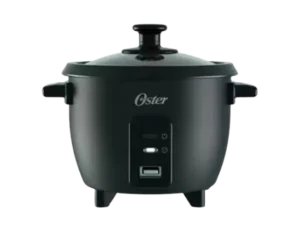
| Brand Name | Oster |
| Product Name | Rice Cooker |
| File Size | 2.45 MB |
| Total Pages | 12 |
| Languages | English and Spanish |
| Electrical Requirement | 120V AC |
| Main Topics Covered | Safety, product parts, first use, rice cooking, steaming, cleaning, warranty and customer support |
Oster Rice Cooker Instructions Manual
This Oster Rice Cooker manual explains how to measure and cook rice, understand the Cook and Keep Warm controls, use the steaming tray on compatible versions, clean the appliance and follow the main safety instructions.
The user guide does not identify a specific consumer model number. The document covers an Oster household rice cooker with a removable inner pot, glass lid, Cook switch, Cook and Keep Warm indicator lights, a 5.33-ounce Oster measuring cup and a rice ladle. A steaming tray is included with select models.
The cooker can prepare up to 5 Oster measuring cups of uncooked rice, which produces up to approximately 10 Oster measuring cups of cooked rice. The measuring cup included with the cooker is different from a standard U.S. measuring cup, so it should be used when following the rice and water markings inside the pot.
Quick Facts
| Feature | Details |
| Brand | Oster |
| Product | Rice Cooker |
| Power requirement | 120V AC |
| Plug type | Polarized |
| Measuring cup | Oster 5.33-ounce rice cooker cup |
| Maximum uncooked rice | 5 Oster measuring cups |
| Approximate cooked capacity | 10 Oster measuring cups |
| Main control | Cook switch |
| Indicator lights | Cook and Keep Warm |
| Steaming tray | Select models only |
| Intended use | Household use only |
| Warranty | 1-year limited warranty |
Important Safety Instructions
The rice cooker produces heat and escaping steam during operation. Keep the appliance on a stable surface and follow the electrical, heat and steam precautions described in the manufacturer instructions.
General safety precautions
- Read the operating instructions before using the appliance.
- Do not touch hot surfaces with bare hands.
- Use handles, knobs or pot holders when handling hot parts.
- Do not immerse the cord, plug or heating unit in water or another liquid.
- Keep close supervision when the cooker is used by or near children.
- Unplug the appliance when it is not in use and before cleaning.
- Allow all parts to cool before removing, installing or cleaning them.
- Do not use the cooker if the cord or plug is damaged.
- Do not operate an appliance that has malfunctioned or been damaged.
- Do not use the rice cooker outdoors.
- Keep the power cord away from heated surfaces.
- Do not let the cord hang over the edge of a table or counter.
- Do not place the cooker on or near a hot gas burner, electric burner or heated oven.
- Take extra care when moving the cooker while it contains hot liquid.
- Use the appliance only for its intended purpose.
- Cook only in the removable inner pot.
- Never pour liquid directly into the heating body.
Safe placement during use
Place the rice cooker on a hard, flat surface.
Leave enough open space above and around the appliance for air circulation. Keep it away from:
- Curtains
- Wall coverings
- Clothing
- Dish towels
- Other flammable materials
Do not leave the cooker unattended while it is operating.
Steam and burn precautions
The cooker generates steam while heating.
- Do not operate it without the lid.
- Keep hands and face away from the steam vent.
- Allow the lid, inner pot and heating plate to cool before touching or cleaning them.
- Do not use an inner pot or lid that is cracked or chipped.
- Never place the inner pot directly on a gas or electric cooktop or over an open flame.
- Do not leave the rice ladle or measuring cup inside the inner pot while the cooker is on.
Electrical and Plug Safety
The rice cooker should be connected to a 120V AC electrical outlet.
It uses a polarized plug, meaning one blade is wider than the other.
If the plug does not fit into the outlet:
- Reverse the plug.
- Try inserting it again.
- If it still does not fit, contact a qualified electrician.
- Do not modify the plug.
Do not use an outlet if the plug fits loosely or if the AC outlet feels warm.
Using an extension cord
A short power cord is provided to reduce the risk of entanglement or tripping.
An extension cord can be used carefully when necessary. Its marked electrical rating should be at least as high as the electrical rating of the rice cooker.
Position the extension cord so it cannot:
- Hang over a countertop or table.
- Be pulled by a child.
- Create a tripping hazard.
Parts and Components
The product diagram identifies the following parts.
| Part | Purpose |
| Glass Lid | Covers the inner pot during cooking and steaming |
| Inner Pot | Holds rice and water |
| Heating Body | Contains the heating system |
| Keep Warm Light | Shows when warming mode is active |
| Cook Light | Shows when the cooker is actively cooking |
| Cook Switch | Starts the cooking cycle |
| Steaming Tray | Used for steaming on select models |
| Handles | Provide handling points on the cooker |
| Oster Measuring Cup | Measures rice for use with the pot markings |
| Rice Ladle | Used for stirring and serving cooked rice |
Buttons and Lights
This Oster rice cooker uses a simple mechanical control system rather than a digital control panel.
Cook switch
The Cook switch starts the cooking cycle.
Push the switch downward after the rice, water, inner pot and lid are correctly positioned.
Once the cooker starts:
- The Cook light turns on.
- The heating cycle begins.
- Steam starts forming shortly afterward.
Keep Warm light
When the cooking water has evaporated:
- The Cook switch automatically pops upward.
- The main cooking cycle stops.
- The Keep Warm light turns on.
This indicates that the cooker has automatically changed from active cooking to warming mode.
Oster rice cooker symbols and settings
The manual does not describe additional display symbols, digital programs or selectable cooking modes.
The primary operating states are:
| Control / Indicator | Meaning |
| Cook switch pushed down | Cooking cycle started |
| Cook light on | Rice is cooking |
| Cook switch pops up | Main cooking cycle has ended |
| Keep Warm light on | Cooker is maintaining warmth |
Included Parts and Accessories
The document does not contain a separate retail package checklist. However, the product diagram identifies the following components:
- Glass lid
- Inner pot
- Heating body
- Rice ladle
- Oster measuring cup
- Steaming tray on select models
The steaming tray is specifically marked as an accessory for select models only, so not every version of this rice cooker necessarily includes one.
Before First Use
Prepare the rice cooker before cooking food for the first time.
- Remove all packaging materials.
- Wash the glass lid in warm, soapy water.
- Wash the inner pot.
- Wash the rice ladle.
- Wash the measuring cup.
- Rinse all washable parts thoroughly.
- Dry them completely.
Do not immerse the heating unit in water or another liquid.
How to Use an Oster Rice Cooker
Correct measurement is important when using this cooker because the supplied Oster measuring cup is not the same size as a standard U.S. measuring cup.
One Oster rice-cooker measuring cup is 5.33 ounces.
The cooker can prepare up to:
- 5 Oster cups of uncooked rice
- Approximately 10 Oster cups of cooked rice
The manufacturer also states that instant rice should not be used in this appliance.
Step 1: Measure the rice
Use the Oster measuring cup that came with the cooker.
Measure the amount of uncooked rice required.
Keep this measuring cup because the numbered water lines inside the inner pot are intended to work with the Oster cup rather than a standard kitchen measuring cup.
Step 2: Rinse the rice
Place the measured rice in a separate bowl.
Rinse it with water until the water becomes clear.
Oster notes that rinsing helps remove bran that can contribute an unpleasant smell to cooked rice. The guide also mentions that some rice suppliers advise against rinsing because nutrients may be lost.
Step 3: Add the rice to the inner pot
Transfer the rinsed rice into the removable inner pot.
Make sure the inner pot is clean before adding rice and water.
Step 4: Add the correct amount of water
Add water after the rice is inside the inner pot.
Use the numbered markings inside the pot.
For example:
5 Oster measuring cups of uncooked rice → fill water to the “5” mark.
This is the measurement method given in the user guide.
What is the Oster rice cooker water-to-rice ratio?
The manual does not give a universal ratio such as 1:1, 1.5:1 or 2:1.
Instead, Oster instructs users to match the amount of rice to the corresponding water-level mark inside the inner pot.
For example, when cooking 5 Oster cups of rice, add water until it reaches the 5 line.
Using the pot markings is more accurate for this cooker than applying a generic rice-to-water ratio that does not appear in the manufacturer instructions.
Step 5: Place the inner pot in the cooker
Set the inner pot inside the heating body.
Turn the pot slightly from left to right until it sits properly on the heating base.
The outside of the inner pot must be completely dry before it is placed on the heating plate.
Step 6: Put the lid on
Cover the cooker with the glass lid.
Do not operate the appliance uncovered because steam generated during use can cause burns or other injury.
Step 7: Start the cooking cycle
- Plug the power cord into a 120V AC outlet.
- Push the Cook switch down.
- Check that the Cook indicator light is illuminated.
- Allow the cooker to operate.
Steaming should begin shortly after the Cook cycle starts.
Step 8: Wait for the cooker to switch to Keep Warm
When the water has evaporated, the Cook switch automatically pops up.
At the same time:
- The Cook cycle ends.
- The Keep Warm indicator comes on.
The guide notes that additional water and another Cook cycle may sometimes be needed depending on the preferred rice texture.
Step 9: Let the rice rest for 10–15 minutes
After the Keep Warm light comes on, leave the lid in place for 10 to 15 minutes.
This allows the rice to continue steaming.
After resting:
- Open the lid carefully.
- Keep hands and face away from escaping steam.
- Use the rice ladle or another long-handled utensil to mix the rice.
- Allow excess steam to escape.
Do not use metal utensils in the inner pot.
Step 10: Unplug after use
Once cooking and serving are complete:
- Disconnect the plug from the wall outlet.
- Allow the appliance to cool completely.
- Clean the cooker before its next use.
How Long Does an Oster Rice Cooker Take?
There is no single cooking time for every quantity and type of rice.
The guide states that brown rice takes longer to cook than white rice. Cooking time can also vary according to the rice type and preferred texture.
One timing reference appears in the section about steaming vegetables while rice cooks. Oster states that producing approximately 10 Oster measuring cups of finished rice takes about 35 minutes.
That figure should be treated as an example rather than a fixed cooking time for every batch.
How to Cook Brown Rice
Brown rice follows the same basic operating process.
- Measure the brown rice with the Oster measuring cup.
- Rinse the rice when appropriate.
- Put the rice into the inner pot.
- Add water using the corresponding pot markings.
- Place the dry inner pot inside the cooker.
- Put the lid on.
- Push the Cook switch down.
- Allow the cooker to complete the cycle.
The manufacturer notes that brown rice takes longer than white rice but does not provide a separate exact brown-rice cooking time.
Oster Rice Cooker Steamer Instructions
Some versions include a steaming tray that fits over the inner pot.
The tray can be used to steam vegetables or other food, either separately or while rice is cooking.
How to use the steaming tray
- Clean and prepare the vegetables or other food.
- Place the inner pot in the heating base.
- Add an appropriate amount of water to the inner pot.
- Put the steaming tray on the rim of the inner pot.
- Place the prepared food in the tray.
- Put the lid on the cooker.
- Push the cooker into the Cook position.
- Steam the food for the appropriate amount of time.
- Unplug the cooker when finished.
The document does not give one fixed amount of water for steaming. Cooking time should be adjusted according to the food and preferred texture.
Vegetable Steaming Times
The following times are listed in the Oster cooking guide.
| Vegetable | Approximate Steaming Time |
| Asparagus | 8–10 minutes |
| Bean sprouts | 3–4 minutes |
| Green, wax or French-cut beans | 8–10 minutes |
| Broccoli | 11–13 minutes |
| Brussels sprouts | 11–13 minutes |
| Shredded cabbage | 6–8 minutes |
| Cabbage wedges | 14–16 minutes |
| Carrots | 8–10 minutes |
| Cauliflower | 11–13 minutes |
| Celery | 8–12 minutes |
| Collard greens / spinach | 6–11 minutes |
| Fresh sliced mushrooms | 3–4 minutes |
| Pea pods | 4–6 minutes |
| Acorn or butternut squash | 13–16 minutes |
| Zucchini | 10–12 minutes |
Altitude affects the temperature at which water boils, so food may require more time at higher elevations.
Check the food when the recommended cooking time has been reached and adjust future steaming time according to the desired texture.
How to Steam Vegetables While Cooking Rice
Food can also be steamed while rice is cooking when the rice cooker has the compatible steaming tray.
- Prepare the rice and follow the normal cooking instructions through placement of the inner pot.
- Set the steaming tray on the rim of the inner pot.
- Place the food inside the tray.
- Put the lid on the cooker.
- Use the vegetable steaming chart to decide when to add the food.
- Allow the rice and vegetables to cook.
- Unplug the appliance when finished.
Most vegetables can be added about 10 minutes before the rice has finished cooking.
The user guide also notes that rice cooking time varies depending on the type of rice and the preferred texture.
Oster Rice Cooker Cooking Tips
Rinse rice thoroughly when appropriate
Rinsing removes bran that may contribute an unpleasant smell to cooked rice.
Some rice suppliers recommend not rinsing because nutrients can be lost, so instructions printed on the rice package should also be considered.
Do not use instant rice
Instant rice is not recommended for this cooker.
Do not use the cooker to heat cold rice
The cooking hints state that the appliance should not remain operating simply to warm cold rice.
Do not operate with utensils inside
Remove the measuring cup and rice ladle from the inner pot before operating the cooker.
Do not let water boil completely dry
The instructions warn against allowing the water in the inner pot to boil dry.
Cleaning and Care Instructions
The rice cooker should be cleaned after every use.
Before cleaning
- Unplug the cooker.
- Allow the appliance to cool completely.
- Do not immerse the heating unit, cord or plug in water or another liquid.
Use the rice ladle or a wooden utensil when removing food from the inner pot. Metal utensils can damage the non-stick surface.
Cleaning the heating body
Wipe the outside of the heating unit lightly with a damp cloth or sponge.
Dry it thoroughly using a soft cloth.
The heating body should not be submerged in water.
Cleaning the inner pot
The inner pot has a non-stick coating.
To clean it:
- Remove the inner pot from the cooker.
- Fill it with hot tap water.
- Allow it to soak for a while.
- Wash it in hot, soapy water.
- Rinse thoroughly.
- Dry completely.
Dishwasher-safe parts
The following components are listed as dishwasher safe:
- Inner pot
- Glass lid
- Rice ladle
- Measuring cup
Removing rice from the heating plate
Rice grains should not remain stuck to the heating plate because they can interfere with contact between the heating surface and the bottom of the inner pot.
If rice becomes stuck:
- Remove the grains promptly.
- Use a non-abrasive pad if necessary.
- Clean and polish the area so the inner pot can sit properly against the heating plate.
Cleaning products to avoid
Do not clean the cooker with:
- Abrasive cleaners
- Scouring pads
- Steel wool
- Bleach
- Vinegar
- Other harsh chemicals
Troubleshooting and Safe Checks
The Oster user guide does not include a dedicated troubleshooting table with detailed fault diagnoses or repair procedures.
The following actions are based only on conditions specifically addressed in the document.
| Problem or Condition | What to Do |
| Cooker malfunctions during use | Unplug it immediately |
| Power cord or plug is damaged | Do not operate the appliance |
| Cooker has been damaged | Stop using it and contact customer service |
| Inner pot is cracked or chipped | Do not use the pot |
| Lid is cracked or chipped | Do not use the lid |
| Plug fits loosely in the outlet | Do not use that outlet |
| Outlet feels warm | Do not use that outlet |
| Rice grains are stuck to the heating plate | Remove them using a non-abrasive pad |
| Cook cycle ends and Keep Warm comes on | This is normal operation |
Do not attempt to repair a malfunctioning rice cooker. The appliance contains no user-serviceable parts, and unauthorized electrical or mechanical repair can also affect warranty coverage.
Technical Specifications
Only the specifications stated in the Oster documentation are included below.
| Specification | Value |
| Brand | Oster |
| Product | Rice Cooker |
| Model number | Not specified |
| Document / Part number | P.N. 147869 |
| Power supply | 120V AC |
| Plug type | Polarized |
| Rice measuring cup | 5.33 ounces |
| Maximum uncooked capacity | 5 Oster measuring cups |
| Approximate cooked capacity | 10 Oster measuring cups |
| Steaming tray | Select models only |
| Intended use | Household use only |
| Wattage | Not stated |
| Product dimensions | Not stated |
| Product weight | Not stated |
Dimensions, wattage, weight and other unstated specifications should not be added from another Oster rice cooker unless that information can be tied to this exact product.
Replacement Parts and Accessories
The document identifies the inner pot, glass lid, rice ladle, measuring cup and optional steaming tray as product components, but it does not provide replacement-part numbers or ordering instructions.
For replacement-part availability, owners should contact Oster customer service rather than assuming that parts from another model are compatible.
Storage Instructions
The guide does not provide a separate long-term storage procedure.
After use:
- Unplug the cooker.
- Allow it to cool completely.
- Clean and dry the removable parts.
- Keep the heating body dry.
- Do not leave food, the rice ladle or measuring cup inside the operating cooker.
No additional storage temperature or environmental limits are stated in the document.
1-Year Limited Warranty
The Oster rice cooker is covered by a 1-year limited warranty.
Sunbeam Products, Inc., doing business as Jarden Consumer Solutions, states that the product will be free from defects in materials and workmanship for one year from the date of purchase.
During the warranty period, JCS may choose to repair or replace the product or a defective component.
A replacement may be:
- New
- Remanufactured
- A similar product of equal or greater value if the original product is no longer available
Warranty requirements
The warranty:
- Applies to the original retail purchaser.
- Begins on the original purchase date.
- Is not transferable.
- Requires proof of purchase.
- Can be voided by unauthorized attempts to repair or adjust electrical or mechanical functions.
What is not covered
The warranty does not cover normal wear or damage resulting from conditions including:
- Negligent use
- Product misuse
- Improper voltage or current
- Use contrary to the operating instructions
- Unauthorized disassembly
- Unauthorized repair
- Unauthorized alteration
It also excludes certain events such as fire, flood, hurricanes and tornadoes.
The full warranty document should be reviewed for all exclusions, legal limitations and regional rights.
Customer Support Information
The user guide lists the following contact details.
| Region | Customer Service |
| United States | 1-800-334-0759 |
| Canada | 1-800-667-8623 |
| Website | www.oster.com |
For warranty service in the United States, call 1-800-334-0759.
For warranty service in Canada, call 1-800-667-8623.
The company provides a service-center address after contact.
Frequently Asked Questions
How do you use an Oster rice cooker?
Measure rice with the supplied Oster measuring cup, rinse it, place it in the inner pot and add water to the matching numbered line. Place the dry inner pot into the cooker, install the lid, plug the unit into a 120V outlet and push the Cook switch down. The cooker automatically changes to Keep Warm when the cooking water has evaporated.
What is the correct Oster rice cooker water-to-rice ratio?
The manufacturer does not state one universal numerical ratio. Use the Oster measuring cup for the rice, then add water to the corresponding numbered line inside the inner pot. For example, 5 Oster cups of rice should be filled with water to the 5 mark.
Which button is Cook on an Oster rice cooker?
The main control is the Cook switch. Push it downward to start cooking. The Cook indicator light should turn on. When cooking finishes, the switch pops up and the Keep Warm light comes on.
What do the Cook and Keep Warm lights mean?
The Cook light indicates that the cooker is actively heating and cooking. The Keep Warm light indicates that the cooking cycle has finished and the cooker has automatically switched to warming mode.
How long does an Oster rice cooker take to cook rice?
Cooking time varies by rice type, amount and preferred texture. Oster does not provide one fixed cooking time. The guide does state that approximately 10 Oster cups of finished rice can take about 35 minutes in the example used for simultaneous rice cooking and steaming.
Can brown rice be cooked in an Oster rice cooker?
Yes. The manual specifically refers to brown rice and states that it takes longer to cook than white rice. It does not provide a separate fixed brown-rice cooking time.
Is this an Oster 3 Cup Rice Cooker manual?
The document does not identify the appliance as an Oster 3 Cup Rice Cooker and does not list a consumer model number. It states that the cooker can prepare up to 5 Oster measuring cups of uncooked rice, producing approximately 10 Oster cups of cooked rice. Owners of a specifically labeled 3-cup model should compare their product information before treating this document as the exact manual for that unit.
Can vegetables be steamed while rice is cooking?
Yes, on versions that include the steaming tray. The tray can sit above the inner pot while the rice cooks. Most vegetables can be added about 10 minutes before the rice finishes, with timing adjusted according to the vegetable and preferred texture.
Is the Oster rice cooker inner pot dishwasher safe?
Yes. Oster states that the inner pot, lid, rice ladle and measuring cup are dishwasher safe.