
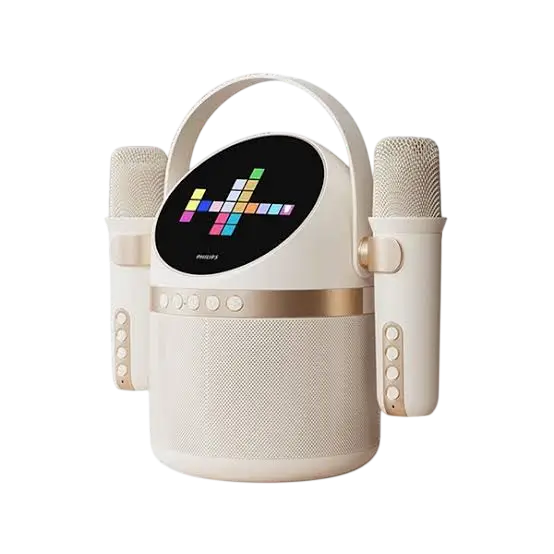
The Philips Wireless Speaker TAS2508 is part of the 2000 Series. It’s a Bluetooth speaker with a built-in rechargeable battery, and it comes with two wireless microphones. You can stream music from a phone or tablet over Bluetooth 5.3. You can also play from a TF card, a USB drive, or a wired AUX connection. The microphones add echo, accompaniment, and six voice effects. The front of the unit has a display screen with selectable light modes. This page covers charging, pairing, controls, specifications, safety, and troubleshooting.
Product Specifications
| Item | Detail |
| Built-in battery | Lithium, 2600 mAh |
| Charging input | 5V 1A (USB) |
| Amplifier output power (RMS) | 5W |
| Frequency response | 90Hz–16KHz |
| Signal-to-noise ratio | >81dB |
| Speaker impedance | 4Ω |
| Maximum input power | 5W |
| Driver diameter | 66mm |
| Driver height | 36.5mm |
| Bluetooth version | 5.3 |
| Bluetooth frequency range | 2402–2480 MHz |
| Maximum transmission power | <10dBm |
| Bluetooth profiles | A2DP, AVCTP, AVRCP, HFP |
| Bluetooth range | Up to 20 m (66 ft) |
| Operating temperature | 0°C to 40°C |
| Main unit size (W x H x D) | 132.4 x 174.5 x 132.4 mm |
| Main unit weight | 686 g |
| Size with microphone (W x H x D) | 209.5 x 174.5 x 132.4 mm |
| Weight with microphone | 850 g |
Specifications can change without notice (p. 7).
What’s in the Box
- Speaker
- Two microphones
- Type-C USB cable
- Quick start guide, safety sheet, and warranty
Parts and Controls
Front of the Speaker
The front panel has five controls:
- Decrease the volume.
- Play or pause playback.
- Turn the speaker on or off. This control also switches between the Bluetooth, TF, AUX, and USB sources.
- Change the light mode.
- Increase the volume.
Back of the Speaker
Four connections sit on the back:
- AUX port, for AUX playback.
- TF card slot, for TF card playback.
- USB port, for USB playback.
- DC input, used to charge the built-in battery.
Microphone Controls
Each microphone has four controls:
- Turn the microphone on or off.
- Switch between MIC, Echo, and Accompaniment modes.
- Raise the volume, or turn accompaniment on.
- Lower the volume, or turn accompaniment off.
A voice-effects control cycles through the six available effects.
Charging and Setup
Fully charge the built-in battery before first use. Follow the setup steps in order (p. 4).
- Connect the speaker’s Type-C socket to a 5V 1A outlet. Use the supplied Type-C cable.
- Watch the LED indicator. It turns red while the speaker or microphone is charging. It goes off when charging is complete.
- Press the power control to turn the speaker on. A prompt sound plays.
- To turn it off, press the same control again. You’ll hear another prompt sound.
Check that your power supply voltage matches the voltage printed on the back or underside of the speaker. When unplugging the USB cable, pull the plug and never the cable. Use only the cable supplied with the speaker or one specified by the manufacturer.
The speaker turns off by itself after 15 minutes with no Bluetooth audio signal.
Playing Music over Bluetooth
Make sure Bluetooth is enabled on your device. Keep the speaker within 20 meters (66 feet) of your device, and keep it away from other electronics that could cause interference.
- Turn the speaker on. It enters Bluetooth pairing mode automatically. You can also enter pairing mode manually by pressing the power control.
- Open the Bluetooth list on your phone or tablet and select “Philips S2508.”
- Play audio on your device to start streaming.
- Press the power control to switch between Bluetooth, TF, AUX, and USB playback.
- Press the light-mode control to change the display lighting.
To disconnect, press and hold the power control until the Marquee light appears. Or open the Bluetooth list on your device, select “Philips S2508,” and cancel the pairing.
Playback and Volume
- Press the play/pause control once to pause or resume.
- Press it twice for the next track.
- Press it three times for the previous track.
- A short press on a volume control changes the volume by one level.
- Holding a volume control changes the volume continuously.
Using the Microphones
Long-press the microphone’s on/off control to turn it on or off. When you power it on, it pairs with the speaker automatically (p. 6).
While the microphone is on, press its mode control to cycle through three modes. The speaker screen shows “M” for MIC, “E” for Echo, and “A” for Accompaniment.
- In MIC or Echo mode: a short press changes volume by one level. A long press changes it continuously.
- In Accompaniment mode: pressing the corresponding controls turns accompaniment on or off.
- Voice effects: a short press on the voice-effects control cycles through six effects. The screen shows effect modes 1 to 6.
Safety Instructions
Read these points before first use (p. 2).
- Keep the speaker away from dripping or splashing water. Don’t set liquid-filled objects or lit candles on top of it.
- Use it indoors only. Keep it away from moisture, direct sunlight, naked flames, and heat.
- Place it on a flat, hard, stable surface. Never put it on other electrical equipment.
- Leave enough free space around the speaker for ventilation.
- Use it only in temperatures between 0°C and 40°C.
- Use only attachments and accessories specified by the manufacturer.
- Never remove the casing. Never lubricate any part of the speaker.
Battery Safety
The speaker contains a built-in lithium battery.
- Replacing it with an incorrect type risks an explosion. Replace it only with the same or an equivalent type.
- Don’t expose the battery to excessive heat such as sunshine or fire.
- Extreme heat, extreme cold, or low air pressure at high altitude during use, storage, or transport can create safety hazards.
- Don’t throw a battery into fire or a hot oven, and don’t crush or cut it. Either can cause an explosion.
- Lithium batteries lose charge over time through self-discharge. If you won’t use the speaker for a while, charge the battery to around 50% every 6 months.
Care and Disposal
The manual gives no cleaning instructions. Its care guidance centers on battery health, keeping the speaker dry and away from heat, and not opening the casing.
Don’t dispose of the speaker or its battery with household waste. Follow your local rules for separate collection of electrical products and batteries. If the integrated battery needs to be removed for disposal, disconnect the product from power first. Recycle packaging according to local regulations.
Troubleshooting
If a problem persists after these checks, go to the Philips support website. Have the speaker nearby, along with its model and serial numbers. Don’t try to repair the speaker yourself, because that can void the warranty (p. 7).
General Problems
| Problem | What to try |
| No power | Make sure the speaker is fully charged and the USB socket is properly connected. Remember the speaker turns off automatically after 15 minutes without an audio signal. |
| No sound | Raise the volume on the speaker and on the connected device. Check that your Bluetooth device is within range. |
| No response | Restart the speaker. |
Bluetooth Problems
| Problem | What to try |
| Poor audio quality after connecting | Move the device closer, and remove any obstacles between the device and the speaker. |
| “Philips S2508” doesn’t appear on your device | Press and hold the power control on the main unit for 3 seconds to enter pairing mode, then try again. |
| Can’t connect | Confirm Bluetooth is enabled on your device. Make sure the speaker is in pairing mode. If the speaker is already connected to another Bluetooth device, disconnect it and try again. |
Frequently Asked Questions
What name does the speaker show when pairing?
It appears as “Philips S2508” in your device’s Bluetooth list.
How far can I be from the speaker?
The Bluetooth range is up to 20 meters (66 feet). Walls and other obstacles between the speaker and your device can degrade the connection and the audio quality.
Why did my speaker turn off by itself?
It’s a power-saving feature. The speaker shuts down after 15 minutes without a Bluetooth audio signal.
How do I charge the speaker, and what does the light mean?
Plug the supplied Type-C cable into the speaker and a 5V 1A power source. The LED indicator is red while charging and goes off when the battery is full.
Can I play music without Bluetooth?
Yes. The speaker also plays from a TF card, a USB drive, and an AUX connection. Use the source control to switch between Bluetooth, TF, AUX, and USB.
How do I use the microphones?
Long-press the microphone’s on/off control. It pairs with the speaker automatically. Then switch between MIC, Echo, and Accompaniment modes, and choose from six voice effects.
How should I store the speaker for a long time?
Charge the built-in lithium battery to around 50% every 6 months while the device isn’t in use. Keep it away from heat, and store it within the 0°C to 40°C temperature range (the stated operating range; the manual gives no separate storage range).
Can I use the speaker outdoors or near water?
No. The manual says to use it indoors only and to keep it away from water and moisture. It’s not rated for dripping or splashing.