
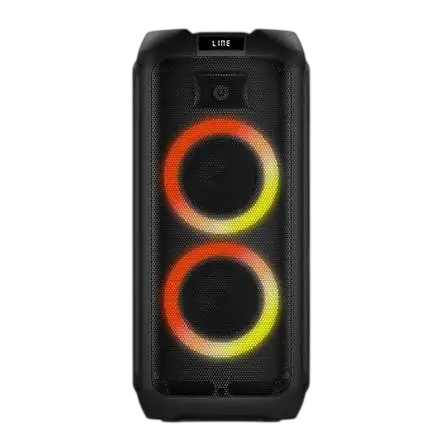
The Philips TAX4209 is a floor-standing Bluetooth party speaker from the 4000 Series. It rates 40W RMS and runs on household AC power. You can play music over Bluetooth 5.0, from a USB drive or TF (microSD) card, from an FM station, or from a wired AUX source. Two microphone jacks and a guitar input let you sing or play through it. You can also record that audio to a USB or TF device. It has ten light effects and a DBB bass boost. If you own two TAX4209 units, you can pair them for stereo (TWS) playback. A remote control is included.
What’s in the Box
- Main unit
- AC power cord
- Remote control (batteries not included)
- Quick start guide
- Safety sheet
- Warranty card
Microphones, a 6.3 mm (1/4″) guitar cable, and an AUX audio cable are not supplied (pp. 11–12).
Product Specifications
| Item | Specification |
| Model | TAX4209 |
| Amplifier power (RMS) | 40W |
| AC power | 100–240V, 50/60 Hz |
| Speaker impedance | Bass 4Ω, Tweeter 6Ω |
| Sensitivity | Bass 88 dB ±3 dB/m/W; Tweeter 89 dB ±3 dB/m/W |
| Frequency response | 40 Hz–20 kHz, −12 dB |
| Signal-to-noise ratio | ≥ 65 dB |
| Total harmonic distortion | ≤ 1% |
| Bluetooth | Version 5.0, 2.402–2.480 GHz ISM band, 10 m (free space) |
| USB | USB 2.0 Full Speed |
| Weight | 10.2 kg |
| Dimensions (W × H × D) | 325.5 × 705 × 325.5 mm |
Parts and Controls
Top panel
The main controls are on the top panel (p. 6–7):
- Power button: turns the speaker on and off.
- MIC in 1 / MIC in 2: microphone inputs.
- Guitar in: guitar input, with its own Guitar vol knob.
- Audio in: AUX input for an external device.
- USB port and TF card slot: for playback and recording.
- Treble, Bass, and Vol knobs: adjust tone and overall volume.
- Mic vol and Echo knobs: adjust microphone level and echo.
- DBB button: switches the bass boost on or off. DBB is off by default.
- Record button: records and plays back your microphone or guitar audio.
- Bluetooth button: switches to Bluetooth mode. A 3-second press disconnects the current device.
- Source button: cycles through Bluetooth, AUX, FM, USB, and TF.
- Light button: cycles through light modes 1–10, then off.
- Previous, Next, and Play/Pause buttons: control playback. They also change radio channels and TWS pairing (see below).
The rear panel has the AC IN socket. The model and serial number are printed on the back of the unit (p. 8).
Remote control
The remote has Mute/Unmute, source switching, number buttons for choosing a track or radio channel, Vol + and Vol −, DBB, Record, previous/next, and play/pause. In USB/TF mode it also toggles between “Repeat ONE” and “Repeat ALL.” If you enter a number higher than the number of tracks or stored channels, there is no response (p. 4).
Insert two AAA (1.5V) batteries with the polarity matching the markings in the compartment. The effective range is 19.7 feet (6 m). Obstacles or other infrared devices nearby can cause erratic operation. Don’t mix old and new batteries or different battery types. Remove the batteries if you won’t use the remote for a long time (p. 5).
Setup and Power
- Check that your outlet’s voltage matches the voltage printed on the back or underside of the speaker.
- Make all other connections first, before connecting to AC power.
- Plug the AC cord into the AC IN socket on the rear panel.
- Plug the other end into a power outlet.
- Press the power button on the top panel to turn the speaker on.
Pull the plug, never the cord, when disconnecting. The plug and outlet type vary by region (p. 8).
Playing Music
Bluetooth
- Press the Bluetooth button or the source button until the screen shows a blinking “bt”.
- On your phone or tablet, turn on Bluetooth and select Philips TAX4209.
- A prompt sound confirms the connection, and the screen stops blinking.
- Play audio on your device and use the previous/next and play/pause buttons to control it.
The range is about 10 meters (30 feet). If the device moves out of range, the speaker disconnects and returns to pairing mode. To connect a different device, disconnect the current one first by long-pressing the Bluetooth button for 3 seconds. To leave Bluetooth, switch to another source (p. 8).
USB or TF card
Insert a USB drive or TF card, and the speaker switches to that source automatically. Playback is MP3 only. Drives and cards up to 128 GB are supported, in FAT, FAT12, FAT16, FAT32, or exFAT format. With a larger device, playback and recording may not work properly (p. 12).
FM radio
Select FM mode until the screen shows a frequency. Long-press the play/pause button for 3 seconds to scan. The speaker saves the stations it finds and plays the first one. Use previous/next to move between saved stations (p. 9).
AUX input
Press the source button until the screen shows “AUX.” Connect an audio cable from the AUX socket to the headphone jack of your device, then start playback on that device (p. 11).
Microphone, Guitar, and Recording
Plug a microphone into MIC in 1 or 2 and set its level with the Mic vol knob. The Echo knob controls echo. For a guitar, use a 6.3 mm connector in the Guitar in jack and set the level with Guitar vol (p. 11).
To record, insert a USB or TF device and attach a microphone or guitar. Recording works in AUX, USB, TF, or FM mode, but not in Bluetooth mode (p. 9).
- Short-press Record to start recording.
- Press play/pause to pause or resume.
- Short-press Record again to stop and return to the current source.
- Long-press Record for 3 seconds to play back the recording.
- While playing back, long-press Record for 3 seconds to delete it.
The speaker creates a “Record” folder for your files. In AUX or FM mode the recording includes the AUX or radio audio along with your mic or guitar. In USB/TF mode it captures only the mic or guitar.
Stereo Pairing (TWS)
TWS works only with two identical Philips TAX4209 speakers (p. 10).
- Turn on both speakers. They enter Bluetooth mode automatically and show a blinking “bt.”
- Long-press the next-track button on either speaker for 3 seconds. You’ll hear a prompt sound from the primary speaker.
- When connected, the primary speaker shows “bt” and the secondary shows “sec.”
- To exit, long-press the same button for 3 seconds on either speaker. Both return to Bluetooth mode.
Light mode, volume, play/pause, DBB, previous/next, treble, and bass are synchronized between the two speakers. The microphone, echo, and guitar controls work only on the primary speaker. The source button on the secondary speaker does nothing. Pressing it on the primary speaker changes the source.
Safety Instructions
- Never remove the casing, and never lubricate any part of the unit.
- Don’t place it on other electrical equipment, near heat sources, or in direct sunlight.
- Keep it away from rain, moisture, dripping, and splashing. Don’t set liquid-filled objects or lit candles on it.
- Don’t use it near water.
- Keep the power cord from being walked on or pinched. Keep the plug accessible so you can disconnect power quickly.
- Unplug the unit during lightning storms or long periods of non-use.
- Use only accessories specified by the manufacturer.
- Have a qualified technician service the unit if it is dropped, the cord or plug is damaged, liquid or objects get inside, it has been exposed to rain, or it stops working normally.
- The manual warns against using controls or procedures other than those described, because of possible hazardous laser exposure. It also advises against looking into the laser beam.
- Keep at least 20 cm between the speaker and your body while its Bluetooth transmitter is operating.
- This is a Class II apparatus with double insulation and no protective earth (p. 14).
Damage caused by not following the instructions isn’t covered by the warranty (p. 2).
Cleaning and Maintenance
Wipe the cabinet with a soft cloth slightly moistened with a mild detergent solution. Don’t use alcohol, spirits, ammonia, or abrasives (p. 12).
Troubleshooting
| Problem | What to try |
| No power | Check that the AC plug is firmly connected and that the outlet has power. |
| No response from the unit | Unplug the AC plug, reconnect it, and turn the unit on again. |
| No sound | Adjust the volume. |
| Some USB files won’t play | The drive may hold more folders or files than the unit can handle, or the file formats aren’t supported. |
| USB device not supported | The device is incompatible. Try another one. |
| Poor audio over Bluetooth | Move the device closer and remove obstacles between them. |
| Can’t connect a Bluetooth device | Make sure Bluetooth is enabled on the device. Disconnect any other device already connected to the speaker, then retry. |
| Bluetooth keeps connecting and disconnecting | Improve reception by moving the device closer and removing obstacles. |
Don’t try to repair the unit yourself, because that voids the warranty. If a problem persists, visit www.philips.com/support and have the model and serial number ready (p. 13).
Frequently Asked Questions
How do I pair my phone with the TAX4209?
Press the Bluetooth or source button until “bt” blinks on the screen. Then choose “Philips TAX4209” in your phone’s Bluetooth settings. A prompt sound tells you the connection worked.
Can I connect two TAX4209 speakers for stereo sound?
Yes, if both are TAX4209 units. Turn both on, then long-press the next-track button on one of them for 3 seconds. The primary speaker shows “bt” and the secondary shows “sec.” Volume, tone, playback, and light settings follow the primary speaker.
What USB and TF card formats does it support?
The speaker plays MP3 files only. Supported file systems are FAT, FAT12, FAT16, FAT32, and exFAT, with a maximum capacity of 128 GB.
Can I record my singing?
Yes. Insert a USB drive or TF card, plug in a microphone, and short-press Record. Recordings are saved in a “Record” folder. Recording isn’t available in Bluetooth mode.
Are the microphone and guitar cable included?
No. The package contains the speaker, AC cord, remote, and printed documents. You’ll need your own microphone and a 6.3 mm guitar cable.
Why won’t my Bluetooth device stay connected?
Weak reception is the usual cause. Keep the device within about 10 meters (30 feet), remove obstacles, and keep other electronic devices that cause interference away. If the device goes out of range, the speaker disconnects and goes back to pairing mode.
What batteries does the remote use?
It takes two AAA (1.5V) batteries, which aren’t included. Match the polarity markings in the compartment. Don’t mix old and new batteries or different battery types.