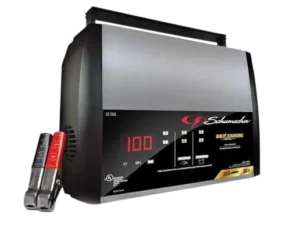
| Field | Details |
| Document Title | Automatic Battery Charger |
| Document Type | Owner’s Manual |
| Brand Name | Schumacher |
| Product Name | Automatic Battery Charger |
| Model Number(s) | SC1393 |
| PDF File Size | 560 KB |
| Number of Pages | 28 |
| Languages | English, Spanish, French |
Schumacher Automatic Battery Charger SC1393
The Schumacher SC1393 Automatic Battery Charger is designed to charge and maintain compatible 6V and 12V rechargeable lead-acid batteries. It supports standard (STD) and Absorbed Glass Mat (AGM) battery types commonly used in cars, motorcycles, garden tractors, snowmobiles, light trucks, and marine applications.
The SC1393 provides up to 12A DC charging current for 12V batteries and 2A DC for 6V batteries. It features automatic voltage detection, selectable charging rates, a digital display, and LED indicators that show charging status, reversed connections, and completed charging.
The charger automatically adjusts charging current according to battery size and condition. Once the battery reaches full charge, it switches to Maintain Mode to keep the battery charged.
Additional functions include battery voltage testing, automatic desulfation, reverse-polarity detection, and diagnostic error codes for charging problems.
Product Features
The Schumacher SC1393 includes the following features:
- Fully automatic battery charging and maintenance.
- Compatible with 6V and 12V lead-acid batteries.
- Supports Standard (STD) and AGM battery types.
- Maximum charging output of 12A DC at 12V.
- Charging output of 2A DC at 6V.
- Automatic battery voltage detection.
- Automatic charging current adjustment.
- Small-battery charging and maintenance setting.
- Automotive, marine, and light-truck charging setting.
- Digital display showing battery voltage and estimated charge percentage.
- Red LED warning for reversed battery clamp connections.
- Yellow/orange LED indicator for active charging.
- Green LED indicator for fully charged and maintaining status.
- Automatic Maintain Mode after charging.
- Automatic Desulfation Mode for sulfated batteries.
- Battery voltage testing function.
- Automatic charging interruption when a fault is detected.
- Diagnostic error codes F01 through F06.
- Auto-start charging protection.
- Automatic display sleep mode during charging.
Technical Specifications
| Specification | Details |
| Brand | Schumacher |
| Model Number | SC1393 |
| Product Type | Automatic Battery Charger |
| AC Input Voltage | 120V AC |
| Input Frequency | 60Hz |
| AC Input Current | 2.9A |
| Supported Battery Voltage | 6V or 12V |
| Voltage Selection | Automatic Voltage Detection |
| Output Current at 6V | 2A DC |
| Output Current at 12V | 12A DC |
| Supported Battery Chemistry | Lead-Acid |
| Supported Battery Types | Standard (STD) and AGM |
| Charging Control | Fully Automatic |
| Charging Current Adjustment | Automatic, According to Battery Size |
| Battery Maintenance | Automatic Float/Maintain Mode |
| Desulfation Function | Automatic |
| Battery Voltage Testing | Yes |
| Digital Battery Percentage Display | Yes |
| Reverse Polarity Indicator | Red Flashing LED |
| Charging Indicator | Yellow/Orange LED |
| Charged/Maintaining Indicator | Green LED |
| Error Code Display | F01–F06 and SUL |
| Warranty | 2-Year Limited Warranty |
Battery Compatibility
The Schumacher SC1393 is intended for charging 6V and 12V rechargeable lead-acid batteries, including Standard and AGM types.
Supported Battery Types
| Battery Type | Compatibility | Description |
| 6V Standard Lead-Acid | Supported | Rechargeable 6V lead-acid batteries |
| 12V Standard Lead-Acid | Supported | Common automotive and other rechargeable lead-acid batteries |
| 6V AGM | Supported | Rechargeable AGM lead-acid batteries |
| 12V AGM | Supported | AGM batteries used in vehicles and other compatible applications |
| Dry-Cell Batteries | Not Supported | Household-type dry-cell batteries must not be charged |
Standard (STD) Batteries
Standard lead-acid batteries are commonly used in cars, trucks, and motorcycles.
These batteries may have removable vent caps and are often identified as low-maintenance or maintenance-free batteries.
They are designed to provide high starting current for applications such as engine starting.
Standard starting batteries should not be used for deep-cycle applications unless their manufacturer specifies otherwise.
AGM Batteries
AGM stands for Absorbed Glass Mat.
In AGM batteries, the electrolyte is held close to the active plate material using glass mat separators.
AGM batteries are a type of sealed valve-regulated lead-acid battery.
Common applications include:
- High-performance vehicle starting.
- Powersports equipment.
- Deep-cycle applications.
- Solar energy storage.
- Other compatible battery storage systems.
Important: The SC1393 must not be used to charge dry-cell batteries commonly found in household appliances. These batteries may burst and cause personal injury or property damage.
Never attempt to charge a frozen battery.
Parts and Control Panel Components
The Schumacher SC1393 includes battery charging clamps, an AC power cord, a digital display, LED status indicators, and charging selection controls.
Main Controls and Indicators
| Component | Function |
| AC Power Cord | Connects the charger to a grounded 120V AC electrical outlet |
| Positive Battery Clamp (Red) | Connects to the appropriate positive battery terminal |
| Negative Battery Clamp (Black) | Connects to the appropriate negative connection point |
| Digital Display | Shows battery voltage, charge percentage, charging status, and error codes |
| Rate Selection Button | Selects the charging rate and changes charging/tester operation |
| Battery Type Button | Selects STD or AGM battery type |
| Clamps Reversed LED (Red) | Flashes when the battery connections are reversed |
| Charging LED (Yellow/Orange) | Illuminates while the battery is charging |
| Charged/Maintaining LED (Green) | Illuminates when charging is complete and Maintain Mode is active |
Control Panel and Button Functions
Rate Selection Button
The Rate Selection button selects the appropriate charging setting.
The charger provides two charging selections.
| Charging Selection | Intended Application |
| Small Battery / Maintain | Small batteries used in garden tractors, snowmobiles, motorcycles, and maintenance of fully charged larger batteries |
| Automotive Charging | Automotive, marine, and light-truck batteries |
The automotive charging setting is not intended for industrial applications.
The charger automatically adjusts the charging current according to battery size.
The Rate Selection button can also be used to stop charging or return the charger to voltage testing mode.
Battery Type Button
The Battery Type button selects the chemistry of the connected lead-acid battery.
The available selections are:
- STD: Standard lead-acid battery.
- AGM: Absorbed Glass Mat lead-acid battery.
The selected battery type should match the battery manufacturer’s specifications.
Digital Display
The digital display provides charging and battery information.
When the charger is connected to a battery but not actively charging, the display shows the battery voltage.
When charging begins, the display changes to ON, followed by the estimated battery charge percentage and the detected 6V or 12V battery voltage.
If charging is manually stopped using the Rate Selection button, the display shows OFF.
Battery Percentage Display
The Battery % function displays the estimated state of charge of the battery connected to the charger clamps.
The percentage is displayed during charging.
Battery Voltage Display
The Voltage function shows the DC voltage measured at the charger clamps.
This reading can be used with the battery voltage chart to assess the battery’s approximate charging condition.
Display Sleep Mode
During charging, the digital display automatically enters sleep mode.
When the display is asleep, the battery percentage and voltage are temporarily hidden.
Press any button to reactivate the display.
LED Indicator Light Guide
The SC1393 uses three primary LED status indicators.
| LED Indicator | Color | Meaning |
| Clamps Reversed | Flashing Red | The battery clamp connections are reversed |
| Charging | Yellow/Orange | The charger is actively charging the battery |
| Charged/Maintaining | Green | The battery is fully charged and the charger has entered Maintain Mode |
Flashing Red LED
A flashing red Clamps Reversed indicator means the battery connections are incorrect.
Disconnect the charger from the AC outlet before correcting the clamps.
Yellow/Orange Charging LED
The yellow/orange indicator illuminates when the battery is receiving charging current.
Green Charged/Maintaining LED
The green LED illuminates when the charger has completed charging and switched to Maintain Mode.
In Maintain Mode, the charger provides a small charging current when necessary to keep the battery fully charged.
Important Safety Instructions
WARNING: Battery charging can produce explosive gases, electrical shock hazards, and serious personal injuries.
The Schumacher SC1393 must be used according to the manufacturer’s safety and operating instructions.
General Safety Precautions
- Read all instructions before using the charger.
- Keep the charger away from children.
- Do not expose the charger to rain or snow.
- Use only attachments recommended or supplied by Schumacher Electric Corporation.
- Disconnect the charger by pulling the plug, not the power cord.
- Do not operate the charger with a damaged electrical cord or plug.
- Do not use a charger that has been dropped, struck, or otherwise damaged.
- Do not disassemble the charger.
- Contact a qualified service technician when repairs are required.
- Unplug the charger before cleaning or maintenance.
- Avoid using extension cords unless absolutely necessary.
Explosive Gas Warning
Lead-acid batteries generate explosive gases during normal operation.
Never smoke or allow sparks or flames near a battery or engine.
Always follow the battery manufacturer’s safety instructions and observe warning labels on the battery, vehicle, and nearby electrical equipment.
Personal Safety Precautions
When working near a lead-acid battery:
- Keep another person nearby who can provide assistance.
- Keep fresh water and soap available.
- Wear appropriate eye and protective clothing.
- Avoid touching the eyes while working near the battery.
- Remove metal jewelry, including rings, bracelets, necklaces, and watches.
- Avoid dropping metal tools onto the battery.
Metal objects can cause short circuits and generate enough heat to cause severe burns.
Battery Acid Exposure
If battery acid contacts the skin or clothing, wash the affected area immediately with soap and water.
If acid enters the eyes, flush the eyes immediately with running cold water for at least 10 minutes and obtain medical attention immediately.
Frozen Battery Warning
Never charge a frozen battery.
Battery Chemistry Restriction
The SC1393 is designed only for compatible 6V and 12V rechargeable lead-acid batteries of the STD or AGM type.
Do not use the charger to recharge household dry-cell batteries.
Vehicle Starting Warning
Do not start the vehicle while the charger is connected to an AC electrical outlet.
Starting the vehicle with the charger connected to AC power may damage the charger.
Before First Use
Initial Preparation
- Remove all cord wraps from the battery charger.
- Uncoil the AC power cord and DC charging cables.
- Inspect the electrical cord, plug, and battery clamps for visible damage.
- Confirm that the battery is a compatible 6V or 12V rechargeable lead-acid battery.
- Identify whether the battery is STD or AGM.
- Position the charger in a safe, ventilated location.
- Make sure the charger is disconnected from AC power before attaching the battery clamps.
Preparing the Battery for Charging
Proper battery preparation helps reduce the risk of sparks and charging problems.
Removing a Battery From a Vehicle
If the battery must be removed from the vehicle, disconnect the grounded battery terminal first.
Make sure all vehicle accessories are switched off before disconnecting the battery.
Battery Ventilation
The area surrounding the battery must be well ventilated during charging.
Cleaning Battery Terminals
Clean the battery terminals before attaching the charger clamps.
Prevent corrosion particles from coming into contact with the eyes.
Checking Battery Electrolyte
For batteries with removable cell caps, add distilled water until the electrolyte reaches the level specified by the battery manufacturer.
Do not overfill the cells.
For sealed or valve-regulated batteries without removable caps, follow the battery manufacturer’s charging instructions.
Checking Battery Voltage
Check the vehicle owner’s manual or battery specifications to confirm whether the battery is rated at 6V or 12V.
The SC1393 automatically detects the battery voltage.
Reviewing Battery Charging Requirements
Follow the battery manufacturer’s instructions regarding charging precautions and recommended charging rates.
Proper Battery Charger Placement
Charger Location
Position the charger as far away from the battery as the DC charging cables allow.
Placement Restrictions
- Do not place the charger directly above the battery.
- Do not place the battery on top of the charger.
- Do not operate the charger in an enclosed area.
- Do not block ventilation around the charger.
- Do not allow battery acid to drip onto the charger.
Battery gases can corrode and damage the charger.
AC Power and Grounding Requirements
The Schumacher SC1393 is intended for use on a nominal 120V AC electrical circuit.
Grounded Electrical Outlet
The charger must be connected to a properly installed and grounded outlet.
The outlet must comply with applicable local electrical codes and regulations.
Grounding Safety
Do not modify the supplied AC plug or power cord.
If the plug does not fit the outlet, have a qualified electrician install a suitable grounded outlet.
An incorrect electrical connection can cause electric shock or electrocution.
Adapter plugs are not permitted under Canadian regulations. The manual also advises against using adapter plugs in the United States.
Extension Cord Requirements
The manufacturer recommends avoiding extension cords unless their use is absolutely necessary.
If an extension cord is required, it must:
- Have plug pins matching the charger plug in number, size, and shape.
- Be correctly wired and in good electrical condition.
- Have sufficient conductor size for the electrical load.
Recommended Extension Cord Wire Sizes
| Extension Cord Length | Minimum Wire Size |
| 25 Feet | 18 AWG |
| 50 Feet | 18 AWG |
| 100 Feet | 16 AWG |
| 150 Feet | 14 AWG |
AWG stands for American Wire Gauge.
Battery Clamp Connection Precautions
Battery clamps must be connected and disconnected only while the charger’s AC power cord is unplugged.
Never allow the red and black battery clamps to touch each other.
The correct clamp connection procedure depends on whether the battery remains installed in a vehicle or is being charged outside the vehicle.
How to Connect the Charger to a Battery Installed in a Vehicle
WARNING: A spark near a battery can cause an explosion.
Preparing the Vehicle
- Turn off all vehicle accessories.
- Open the vehicle hood.
- Clean the battery terminals.
- Position the charger on a dry, nonflammable surface.
- Route the charging cables away from fan blades, belts, pulleys, and moving engine components.
- Identify the positive and negative battery terminals.
- Determine which battery terminal is grounded to the vehicle chassis.
Negative-Grounded Vehicles
Most vehicles use a negative-ground electrical system.
For a negative-grounded vehicle:
- Connect the positive (red) clamp to the positive battery terminal marked POS, P, or +.
- Connect the negative (black) clamp to the vehicle chassis or engine block, away from the battery.
- Use a heavy-gauge metal section of the frame or engine block for the negative connection.
Do not connect the negative clamp to the carburetor, fuel lines, or thin sheet-metal body parts.
Positive-Grounded Vehicles
For a vehicle with a positive-ground electrical system:
- Connect the negative (black) clamp to the negative battery terminal marked NEG, N, or –.
- Connect the positive (red) clamp to the vehicle chassis or engine block, away from the battery.
- Use a heavy-gauge metal section of the frame or engine block.
Do not attach the chassis clamp to fuel lines, carburetors, or thin sheet-metal body parts.
Disconnecting the Charger From a Vehicle Battery
When charging is complete:
- Stop charging if necessary.
- Disconnect the AC power cord from the electrical outlet.
- Remove the clamp attached to the vehicle chassis.
- Remove the clamp connected to the battery terminal.
How to Connect the Charger to a Battery Outside the Vehicle
A battery removed from a vehicle requires a different connection procedure.
Required Negative Battery Cable
Use an insulated 6 AWG battery cable at least 24 inches (61cm) long.
Connecting the Charger
- Place the battery in a well-ventilated location.
- Identify the positive and negative battery terminals.
- Attach the 24-inch or longer insulated 6 AWG cable to the negative battery terminal.
- Connect the charger’s positive (red) clamp to the positive battery terminal.
- Position the free end of the attached negative cable as far from the battery as possible.
- Connect the charger’s negative (black) clamp to the free end of that cable.
- Do not face the battery while making the final connection.
- Connect the charger to AC power and select the appropriate charging settings.
Disconnecting the Charger
When charging is complete:
- Unplug the charger from AC power.
- Disconnect the clamps in the reverse order of connection.
- Make the first disconnection as far from the battery as practical.
Charging Marine Batteries
A marine battery must be removed from the boat and charged on shore.
Charging a battery while it remains aboard a boat requires equipment specifically designed for marine use.
How to Charge a Battery With the Schumacher SC1393
The Schumacher SC1393 uses automatic charging controls to charge compatible lead-acid batteries.
Charging a Battery Installed in a Vehicle
- Turn off all vehicle accessories.
- Keep the vehicle hood open.
- Clean the battery terminals.
- Place the charger on a dry, nonflammable surface.
- Route the AC and DC cables away from moving engine parts.
- Connect the battery clamps using the correct vehicle grounding procedure.
- Connect the charger to a grounded AC outlet.
- Select the correct battery type using the Battery Type button.
- Select the appropriate charging rate using the Rate Selection button.
- Allow the charger to complete the automatic charging process.
- When charging is complete, disconnect AC power.
- Remove the chassis clamp.
- Remove the clamp attached to the battery terminal.
Charging a Battery Outside the Vehicle
- Place the battery in a well-ventilated area.
- Clean the battery terminals.
- Connect the charger clamps using the outside-vehicle battery procedure.
- Plug the charger into a grounded AC outlet.
- Select the correct battery type and charging rate.
- Allow charging to complete.
- Disconnect AC power.
- Remove the negative clamp.
- Remove the positive clamp.
Charging Rate Settings
The SC1393 offers charging selections for small batteries and automotive batteries.
Small Battery Charging
The small-battery setting is intended for batteries commonly found in:
- Garden tractors.
- Snowmobiles.
- Motorcycles.
This setting is also used to maintain fully charged larger batteries.
Automotive Battery Charging
The higher charging setting is intended for:
- Automotive batteries.
- Marine batteries.
- Light-truck batteries.
This setting is not intended for industrial applications.
Automatic Current Adjustment
The charger automatically adjusts charging current based on battery size.
The technical output ratings are:
| Battery Voltage | Rated Output Current |
| 6V | 2A DC |
| 12V | 12A DC |
Battery Charging Times
Charging time depends on the battery’s capacity, state of charge, age, and overall condition.
The manufacturer’s charging-time chart uses batteries that begin at approximately 50% charge.
Actual charging times may vary.
The charger automatically controls charging current and changes to Maintain Mode when charging is complete.
Automatic Charging Mode
The SC1393 begins charging when a compatible battery is correctly connected and the charging settings are selected.
During automatic charging:
- The charger detects the connected battery voltage.
- Charging starts after the correct settings are selected.
- The digital display shows the charging status and estimated battery percentage.
- The charger adjusts the charging current based on battery size.
- Charging continues until the battery reaches full charge.
- The charger automatically switches to Maintain Mode.
Auto-Start Function
The Schumacher SC1393 includes an automatic charging start function.
The charger does not supply charging current to the clamps until a battery is properly connected.
The clamps do not spark when touched together because the charger does not energize them without a proper battery connection.
Important: The clamps must still never be deliberately connected to each other.
Automatic Desulfation Mode
The SC1393 includes an automatic Desulfation Mode for batteries showing signs of sulfation.
What Does SUL Mean on the Schumacher Battery Charger?
When the charger detects a sulfated battery, the digital display shows:
SUL
The charger then enters Desulfation Mode automatically.
Desulfation Process
- The charger detects a sulfated battery.
- The display shows SUL.
- The charger attempts to desulfate the battery.
- If desulfation is unsuccessful after 10 hours, charging is aborted.
- The display shows bAd / bAt / F02.
If the battery cannot be desulfated, it must be checked or replaced.
Aborted Charge Mode
The charger automatically aborts charging when the battery cannot be charged normally.
Aborted Charging Indicators
When charging is aborted:
- The charger stops supplying charging current.
- The digital display shows bAd / bAt and an error code.
- Charging is discontinued.
Do not continue attempting to charge a battery after an aborted charge indication.
Have the battery checked or replaced.
Automatic Maintain Mode
The SC1393 automatically enters Maintain Mode when the battery reaches full charge.
Charged/Maintaining Indicator
When the battery is fully charged, the green Charged/Maintaining LED illuminates.
This indicates that the charger has switched from charging to maintenance operation.
How Maintain Mode Works
In Maintain Mode, the charger supplies a small amount of charging current when necessary to keep the battery fully charged.
This allows the charger to maintain healthy 6V and 12V batteries over extended periods.
Maintain Mode Protection
If the charger must supply its maximum maintenance current continuously for 12 hours, it enters Aborted Charge Mode.
This can occur because of:
- Electrical loads draining the battery.
- A battery that cannot retain charge.
- Battery or vehicle electrical problems.
Corrective Action
- Check for electrical loads connected to the battery.
- Remove any unnecessary loads.
- If no loads are present, have the battery checked or replaced.
Monitoring During Maintenance
The manufacturer’s maintenance technology allows extended charging and maintenance of a healthy battery.
However, occasional monitoring is required because electrical faults, incorrect connections, and battery problems can cause excessive current consumption.
How to Use the Battery Voltage Tester
The SC1393 can display the DC voltage of a connected battery.
Battery Voltage Testing Instructions
- Make sure the charger is disconnected from the AC outlet.
- Connect the charger clamps to the battery using the correct connection procedure.
- Plug the charger into the AC outlet.
- Select the correct battery type if necessary.
- Read the battery voltage on the digital display.
- Compare the reading with the battery voltage chart.
The voltage reading represents the voltage measured at the charger clamps.
A temporary surface charge can affect the reading, so the result may not accurately represent the battery’s condition.
Battery Voltage Reference Chart
| 6V Battery Reading | 12V Battery Reading | Battery Condition |
| 6.4V or Higher | 12.8V or Higher | Charged |
| 6.1–6.3V | 12.2–12.7V | Needs Charging |
| Below 6.1V | Below 12.2V | Discharged |
Automatic Tester-to-Charger Switching
If no button is pressed within 10 minutes after the charger is powered on, the unit automatically switches from voltage testing to charging when a battery is connected.
Under this condition, the charger selects the small-battery charging rate and AGM battery type.
Returning to Voltage Testing Mode
After the charger has been changed from tester to charging operation, press the Rate Selection button until all charging-rate LEDs are off.
The charger then returns to voltage testing operation.
Cleaning and Maintenance Instructions
Regular maintenance helps keep the Schumacher SC1393 operating properly.
Cleaning the Battery Clamps
Clean the battery clamps after each charging session.
Wipe away battery fluid that may have come into contact with the clamps to help prevent corrosion.
Cleaning the Charger Housing
Clean the charger case occasionally using a soft cloth.
This helps maintain the exterior finish and reduces the possibility of corrosion.
Cleaning Safety
Disconnect the charger from the AC power outlet before performing cleaning or maintenance.
Turning off the controls alone does not eliminate the risk of electric shock.
Storage Instructions
Proper Storage Procedure
- Disconnect the charger from the AC power outlet.
- Coil the AC input and DC output cables neatly.
- Store the charger in an upright position.
- Keep the charger indoors in a cool, dry location.
- Store the battery clamps separately without connecting them together.
Battery Clamp Storage Precautions
Do not store the clamps:
- Clipped together.
- Attached to the charger’s handle.
- Attached to metal objects.
- Clipped to the charging cables.
Proper storage helps prevent accidental damage to the charger and cables.
Schumacher SC1393 Error Codes
The SC1393 displays diagnostic codes when it detects battery charging problems.
Error Code Reference Table
| Error Code | Meaning | Recommended Action |
| F01 | Battery voltage remains below 10V for a 12V battery or 5V for a 6V battery after 2 hours of charging | Have the battery checked or replaced |
| SUL | Sulfated battery detected | Charger enters Desulfation Mode automatically |
| F02 | Desulfation was unsuccessful | Have the battery checked or replaced |
| F03 | Battery failed to reach full-charge voltage | Try a higher charging setting or have the battery checked or replaced |
| F04 | Battery clamp connections are reversed | Unplug the charger and correct the connections |
| F05 | Battery cannot remain fully charged in Maintain Mode | Remove battery loads; have the battery checked or replaced |
| F06 | Battery may be overheating due to thermal runaway | Charger stops current automatically; have the battery checked or replaced |
Schumacher F01 Error Code
The F01 code appears when the battery voltage remains below:
- 10V for a 12V battery.
- 5V for a 6V battery.
This occurs after 2 hours of charging.
The battery may be defective and should be checked or replaced.
Schumacher SUL Code
The SUL display indicates that the charger has detected a sulfated battery.
The charger automatically attempts desulfation.
If desulfation is unsuccessful after 10 hours, charging is aborted and F02 appears.
Schumacher F02 Error Code
F02 indicates that the charger could not successfully desulfate the battery.
The battery should be checked or replaced.
Schumacher F03 Error Code
F03 indicates that the battery could not reach the required full-charge voltage.
This may occur when charging a large battery or battery bank using a charging current setting that is too low.
Try a higher charging setting, or have the battery checked or replaced.
Schumacher F04 Error Code
F04 indicates reversed battery connections.
To correct the problem:
- Unplug the charger from the AC outlet.
- Check the positive and negative battery terminals.
- Correct the clamp connections using the appropriate connection procedure.
- Resume charging.
Schumacher F05 Error Code
F05 indicates that the charger could not keep the battery fully charged during Maintain Mode.
The problem may result from electrical loads connected to the battery or a battery that cannot hold its charge.
Remove unnecessary loads.
If no loads are present, have the battery checked or replaced.
Schumacher F06 Error Code
F06 indicates that the charger has detected possible battery overheating or thermal runaway.
The charger automatically stops supplying charging current.
Have the battery checked or replaced.
Troubleshooting Guide
Schumacher SC1393 Troubleshooting Table
| Problem | Possible Cause | Recommended Solution |
| Battery Clamps Do Not Spark When Touched Together | Normal Auto-Start function | No repair required |
| Three LEDs Illuminate for 2 Seconds and Turn Off | Normal startup after connection to AC power | No repair required |
| Charger Does Not Turn On | Electrical outlet has no power | Check the outlet fuse or circuit breaker |
| Charger Does Not Turn On | Poor electrical connection | Check the power cord and extension cord connections |
| Charger Does Not Turn On | Defective battery | Have the battery checked |
| Cannot Select 6V or 12V | Automatic voltage detection | Normal operation |
| Battery Percentage Is Not Displayed | Charger is displaying voltage before charging | Battery percentage appears during charging |
| Display Shows F01 | Battery voltage remains too low after 2 hours | Remove loads; have the battery checked or replaced |
| Display Shows F02 | Desulfation unsuccessful after 10 hours | Have the battery checked or replaced |
| Display Shows F05 | Maintain Mode cannot keep the battery charged | Remove loads; have the battery checked or replaced |
Schumacher SC1393 Not Turning On
If the charger does not turn on when properly connected, check the following conditions.
Electrical Outlet Has No Power
Check whether the electrical outlet is receiving power.
Inspect the fuse or circuit breaker supplying the outlet.
Poor Electrical Connection
Check the AC power cord and any extension cord for loose or improper connections.
Defective Battery
If the outlet and electrical connections are functioning normally, have the battery checked.
Schumacher SC1393 Not Showing Battery Percentage
When the charger is first connected to a battery, the digital display shows battery voltage.
The estimated charge percentage is displayed during active charging.
During charging, the display may also enter sleep mode.
Press any button to reactivate the display.
Schumacher SC1393 Not Detecting Battery Voltage Setting
The SC1393 uses automatic voltage detection.
The charger identifies whether the connected battery is 6V or 12V.
Manual selection between 6V and 12V is not required.
Schumacher SC1393 Battery Not Charging
If the charger does not charge the connected battery:
- Check that the AC outlet has power.
- Check the AC power cord connection.
- Confirm that the battery clamps are properly connected.
- Check whether the red Clamps Reversed LED is flashing.
- Confirm that the selected battery type is correct.
- Check the digital display for an error code.
- Follow the corresponding error-code instructions.
If the battery repeatedly fails to charge or charging is aborted, have the battery checked or replaced.
Schumacher SC1393 Stuck in Desulfation Mode
The SUL display indicates that the charger has detected a sulfated battery.
The charger automatically attempts desulfation.
If the process is unsuccessful after 10 hours, the charger aborts charging and displays bAd / bAt / F02.
The battery must then be checked or replaced.
Schumacher SC1393 Not Maintaining Battery Charge
If the charger cannot keep the battery charged during Maintain Mode, check for electrical loads that may be discharging the battery.
Remove connected loads where applicable.
If no external loads are present, the battery may be defective and should be checked or replaced.
Limited Warranty
Schumacher Electric Corporation provides a two-year limited warranty for the SC1393 Automatic Battery Charger.
Warranty Information
| Warranty Detail | Information |
| Manufacturer | Schumacher Electric Corporation |
| Product | Automatic Battery Charger SC1393 |
| Warranty Type | Limited Warranty |
| Warranty Period | 2 Years |
| Warranty Start Date | Original Retail Purchase Date |
| Eligible Purchaser | Original Retail Purchaser |
| Transferability | Not Transferable |
| Covered Defects | Defective Materials or Workmanship Under Normal Use and Care |
| Warranty Remedy | Repair or Replacement at Manufacturer’s Discretion |
| Warranty Validity in Mexico | Not Valid |
Warranty Repair or Replacement
If the charger develops a covered defect during the warranty period, Schumacher Electric Corporation may repair the product or replace it with a new or reconditioned unit.
The manufacturer determines whether repair or replacement is appropriate.
The purchaser must provide proof of purchase and pay shipping charges in advance when sending the product to the manufacturer or an authorized representative.
Warranty Exclusions
The limited warranty does not cover accessories that are not manufactured and approved by Schumacher Electric Corporation.
The warranty may be void if the product:
- Is misused.
- Is handled carelessly.
- Is repaired or modified by someone other than the manufacturer.
- Is resold through an unauthorized retailer.
The warranty also contains limitations concerning other warranties and incidental or consequential damages. Applicable legal rights may vary by state.
Warranty Registration
The product can be registered online at:
The warranty card should be submitted within 30 days of purchase.
Keep the original purchase receipt because it is required for warranty claims.
Customer Support and Repair Information
Schumacher Electric Corporation provides customer assistance for charging problems, troubleshooting, warranty inquiries, repairs, and returns.
Customer Support Details
| Service | Contact Information |
| Manufacturer | Schumacher Electric Corporation |
| Customer Support Phone | 1-800-621-5485 |
| Customer Support Email | services@schumacherelectric.com |
| Website | www.batterychargers.com |
| Manufacturer Address | 801 Business Center Drive, Mount Prospect, IL 60056-2179, USA |
Repair and Return Procedure
- Review the troubleshooting instructions.
- Identify the charging problem or error code.
- Contact Schumacher customer service at 1-800-621-5485.
- Request repair or return assistance.
- Obtain a Return Merchandise Authorization (RMA) number.
- Follow the manufacturer’s shipping instructions.
Important: Do not ship the charger until Schumacher Electric Corporation Customer Service has issued an RMA number.
Frequently Asked Questions
1. Can the Schumacher SC1393 charge both 6V and 12V batteries?
Yes. The Schumacher SC1393 can charge compatible 6V and 12V rechargeable lead-acid batteries, including STD and AGM types. It uses automatic voltage detection to identify the connected battery voltage. The charger provides 2A DC output at 6V and up to 12A DC at 12V.
2. How do I know when the Schumacher SC1393 battery charger is fully charged?
The green Charged/Maintaining LED illuminates when the connected battery reaches full charge. The charger automatically switches to Maintain Mode, where it supplies a small current when necessary to keep the battery charged.
3. What does SUL mean on the Schumacher SC1393 charger?
SUL means the charger has detected a sulfated battery and entered Desulfation Mode. The charger automatically attempts to desulfate the battery. If the process is unsuccessful after 10 hours, charging is aborted and the display shows bAd / bAt / F02.
4. What does F01 mean on the Schumacher SC1393 charger?
F01 indicates that the battery voltage remains below 10V for a 12V battery or below 5V for a 6V battery after 2 hours of charging. The battery may be defective and should be checked or replaced.
5. Why is the red light flashing on the Schumacher SC1393?
A flashing red Clamps Reversed LED indicates that the battery clamp connections are reversed. Unplug the charger from the AC outlet and correct the positive and negative connections using the appropriate battery connection procedure.
6. Can the Schumacher SC1393 maintain a battery for extended periods?
Yes. The SC1393 automatically enters Maintain Mode when charging is complete. It supplies a small charging current when necessary to keep a healthy 6V or 12V battery charged. The battery and charging process should still be monitored occasionally because battery problems or external electrical loads can cause excessive current consumption.
7. Why does the Schumacher SC1393 show F05?
F05 indicates that the charger cannot keep the battery fully charged during Maintain Mode. This may be caused by electrical loads draining the battery or a battery that cannot hold its charge. Remove unnecessary loads and have the battery checked or replaced if the problem continues.
8. Can the Schumacher SC1393 charge AGM batteries?
Yes. The Schumacher SC1393 supports compatible AGM lead-acid batteries. The Battery Type button allows selection of AGM or Standard (STD) battery settings. The selected setting should match the battery manufacturer’s specifications.